
|
You entered: constellation
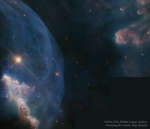 Close up of the Bubble Nebula
3.04.2016
It's the bubble versus the cloud. NGC 7635, the Bubble Nebula, is being pushed out by the stellar wind of massive central star BD+602522. Next door, though, lives a giant molecular cloud, visible to the right. At this place in space, an irresistible force meets an immovable object in an interesting way.
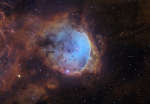 NGC 3324 in Carina
6.04.2018
This bright cosmic cloud was sculpted by stellar winds and radiation from the hot young stars of open cluster NGC 3324. With dust clouds in silhouette against its glowing atomic gas, the pocket-shaped star-forming region actually spans about 35 light-years. It lies some 7,500 light-years away toward the nebula rich southern constellation Carina.
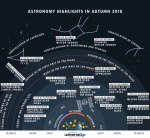 Highlights of the North Autumn Sky
25.09.2018
What can you see in the night sky this season? The featured graphic gives a few highlights for Earth's northern hemisphere. Viewed as a clock face centered at the bottom, early (northern) autumn sky events fan out toward the left, while late autumn events are projected toward the right.
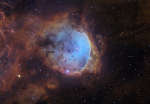 NGC 3324 in Carina
16.03.2019
This bright cosmic cloud was sculpted by stellar winds and radiation from the hot young stars of open cluster NGC 3324. With dust clouds in silhouette against its glowing atomic gas, the pocket-shaped star-forming region actually spans about 35 light-years. It lies some 7,500 light-years away toward the nebula rich southern constellation Carina.
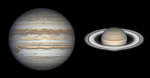 The Giants of Summer
29.07.2020
As Comet NEOWISE sweeps through northern summer skies, Jupiter and Saturn are shining brightly, near opposition. With Jupiter opposite the Sun on July 14 and Saturn on July 21, the giant planets are still near their closest to planet Earth in 2020.
 Giant Galaxies in Pavo
23.06.2023
Over 500,000 light years across, NGC 6872 (top right) is a truly enormous barred spiral galaxy, at least 5 times the size of our own very large Milky Way. The appearance of this giant galaxy's distorted and stretched out spiral arms suggests the magnificent wings of a giant bird.
 The Elephant s Trunk in Cepheus
21.11.2024
Like an illustration in a galactic Just So Story, the Elephant's Trunk Nebula winds through the emission region and young star cluster complex IC 1396, in the high and far off constellation of Cepheus. Also known as vdB 142, this cosmic elephant's trunk is over 20 light-years long.
 NGC6366 vs 47 Ophiuchi
23.05.2025
Most globular star clusters roam the halo of our Milky Way galaxy, but globular cluster NGC 6366 lies close to the galactic plane. About 12,000 light-years away toward the constellation Ophiuchus, the cluster's starlight is dimmed and reddened by the Milky Way's interstellar dust when viewed from planet Earth.
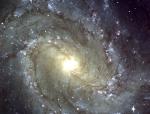 M83: The Southern Pinwheel Galaxy from VLT
6.12.1999
M83 is one of the closest and brightest spiral galaxies on the sky. Visible with binoculars in the constellation of Hydra, majestic spiral arms have prompted its nickname as the Southern Pinwheel. Although discovered...
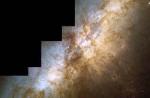 M82 After the Crash
12.03.2001
When did the Cigar Galaxy light up? Evidence indicates how M82, the Cigar Galaxy, became so bright and peculiar: it collided with neighboring galaxy M81. Astronomers become detectives, however, when trying to figure out when this collision occurred.
|
January February March April May June July August September October |
|||||||||||||||||||||||||||||||||||||||||||||||||