
|
You entered: NASA
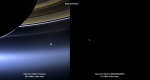 Two Views of Earth
23.07.2013
In a cross-Solar System interplanetary first, our Earth was photographed during the same day from both Mercury and Saturn. Pictured on the left, Earth is the pale blue dot just below the rings of Saturn, as captured by the robotic Cassini spacecraft now the gas giant.
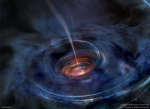 Black Hole Accreting with Jet
27.03.2017
What happens when a black hole devours a star? Many details remain unknown, but recent observations are providing new clues. In 2014, a powerful explosion was recorded by the ground-based robotic telescopes of the All Sky Automated Survey for SuperNovae (ASAS-SN) project, and followed up by instruments including NASA's Earth-orbiting Swift satellite.
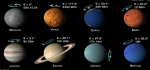 Planets of the Solar System: Tilts and Spins
20.05.2019
How does your favorite planet spin? Does it spin rapidly around a nearly vertical axis, or horizontally, or backwards? The featured video animates NASA images of all eight planets in our Solar System to show them spinning side-by-side for an easy comparison.
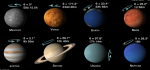 Planets of the Solar System: Tilts and Spins
11.09.2022
How does your favorite planet spin? Does it spin rapidly around a nearly vertical axis, or horizontally, or backwards? The featured video animates NASA images of all eight planets in our Solar System to show them spinning side-by-side for an easy comparison.
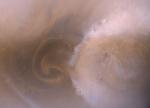 A Polar Martian Dust Storm
9.10.2000
On August 29, a large dust storm was photographed erupting out from the north polar cap of Mars. Such dust storms are not uncommon as summer advances in the north. In the above picture...
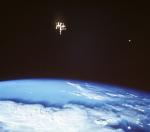 The Moons Of Earth
27.01.2001
While orbiting the planet during their June 1998 mission, the crew of the Space Shuttle Discovery photographed this view of two moons of Earth. Thick storm clouds are visible in the lovely blue planet...
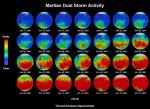 Martian Dust Storm
27.07.2001
If you've been unhappy with the weather on Earth, check out Mars, now in the grip of a planet-wide dust storm. Above, observations from the orbiting Mars Global Surveyor (MGS) spacecraft illustrate the storm's progress through July 21.
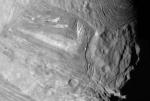 Miranda, Chevron, and Alonso
16.02.2002
Miranda is a bizarre world which surely had a tempestuous past. The innermost of the larger Uranian moons, Miranda is almost 300 miles in diameter and was discovered on today's date in 1948 by American planetary astronomer Gerard Kuiper.
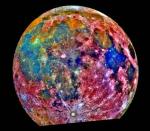 The Colorful Moon
16.03.2002
Do you recognize the Earth's Moon when you see it? The crazy, patchwork appearance of the false-color image makes this almost full view of the Moon's familiar near side look very strange.
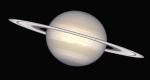 Natural Saturn On The Cassini Cruise
11.05.2002
What could you see approaching Saturn aboard an interplanetary cruise ship? Your view would likely resemble this subtly shaded image of the gorgeous ringed gas giant. Processed by the Hubble Heritage project, the picture...
|
January February March April May June July August September October |
|||||||||||||||||||||||||||||||||||||||||||||||||