
|
You entered: NASA
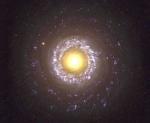 Spiral Galaxy NGC 7742
26.07.2003
This might resemble a fried egg you've had for breakfast, but it's actually much larger. In fact, ringed by blue-tinted star forming regions and faintly visible spiral arms, the yolk-yellow center of this face-on spiral galaxy, NGC 7742, is about 3,000 light-years across.
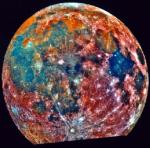 The Colorful Moon
7.01.1998
Do you recognize the Earth's Moon when you see it? The crazy, patchwork appearance of this false color image makes this nearly full view of our Moon's familiar nearside look very strange. The image was taken in 1992 by the Galileo spacecraft enroute to Jupiter.
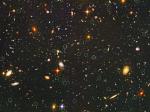 HUDF: Dawn of the Galaxies
29.09.2004
When did galaxies form? Faint red smudges identified on the deepest optical sky image ever taken may well be members of the first class of galaxies. Detailed inspection of the Hubble Ultra Deep Field...
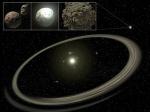 Old Planetary Dust Disks Found by SST
19.10.2004
Why are some older stars surrounded by dust? Observations from the Spitzer Space Telescope by a team led by George Rieke (U. Arizona) were expected to show that young stars, on the order of one million years old, have large dust disks, while relatively older stars, between 10 and 100 million years old, have none.
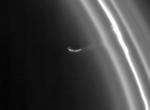 Prometheus and the Rings of Saturn
17.12.2004
In Greek Mythology, Prometheus was known for stealing fire from the gods. Ironically, in a story for more modern times Prometheus may also become known for stealing, but this time for stealing icy particles from Saturn's rings.
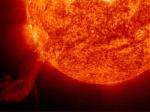 A Solar Prominence from SOHO
9.11.2005
What happened to the Sun? Nothing very unusual: the strange-looking solar appendage on the lower left is actually just a spectacular looking version of a common solar prominence. A solar prominence is a cloud of solar gas held above the Sun's surface by the Sun's magnetic field.
 Dust Storm on Planet Earth
3.03.2000
From low Earth orbit, NASA's SeaWIFS instrument records ocean color, tracking changes in our water world's climate and biosphere. But even an ocean planet can have dust storms. On February 26th, SeaWIFS...
 Galaxy Evolution Tracking Animation
30.05.2016
How did the universe evolve from such a smooth beginning? To help understand, computational cosmologists and NASA produced the featured time-lapse animated video depicting a computer simulation of part of the universe. The 100-million light-year simulation starts about 20 million years after the Big Bang and runs until the present.
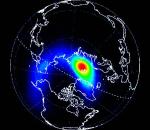 X-Ray Earth
16.09.2000
Above is a picture of the Earth in x-rays, taken in March of 1996 from the orbiting Polar satellite. Most of the planet is dark with superposed continent and coordinate grids, while the bright x-ray emission near the north pole is shown in red. Why does the Earth have an x-ray glow?
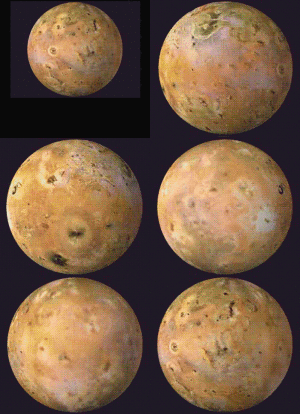 Io Rotating
24.10.2000
The surface of Io is continually changing. Jupiter's moon is the home to many powerful volcanoes so active they are effectively turning the moon inside out. The above time-lapse sequence is a composite of images taken during two space missions that approached the violent moon: Voyager and Galileo.
|
January February March April May June July August September October |
|||||||||||||||||||||||||||||||||||||||||||||||||