
|
You entered: NASA
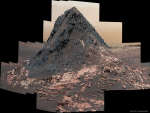 Ireson Hill on Mars
19.07.2017
What created this unusual hill on Mars? Its history has become a topic of research, but its shape and two-tone structure makes it one of the more unusual hills that the robotic Curiosity rover on Mars has rolled near. Dubbed Ireson Hill, the mound rises about 5 meters high and spans about 15 meters across.
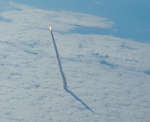 Space Shuttle Rising
15.04.2018
What's that rising from the clouds? The space shuttle. Sometimes, if you look out the window of an airplane at just the right time and place, you see something unusual -- in this case a space shuttle launching to orbit.
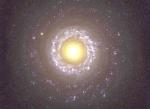 Spiral Galaxy NGC 7742
1.07.2001
This might resemble a fried egg you've had for breakfast, but it's actually much larger. In fact, ringed by blue-tinted star forming regions and faintly visible spiral arms, the yolk-yellow center of this face-on spiral galaxy, NGC 7742, is about 3,000 light-years across.
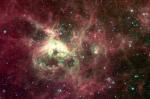 The Tarantula Nebula from Spitzer
2.02.2004
In the heart of monstrous Tarantula Nebula lies one of the most unusual star clusters. Known as NGC 2070 or R136, it is home to a great number of hot young stars. The energetic light from these stars continually ionizes nebula gas, while their energetic particle wind blows bubbles and defines intricate filaments.
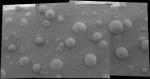 A Patch of Spherules on Mars
16.02.2004
Some patches of Mars are full of mysterious tiny spherules. The microscopic imager on board the Opportunity rover on Mars recorded, last week, the above image showing over a dozen. The image was taken near a rock outcrop called Stone Mountain and spans roughly 6 centimeters across.
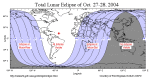 Total Lunar Eclipse Tonight
27.10.2004
Go outside tonight and see the total lunar eclipse. Tonight's eclipse is easy and convenient for much of the world to see. Anyone who can spot a full Moon -- even during the day -- can see it fade out as the Earth's shadow engulfs it.
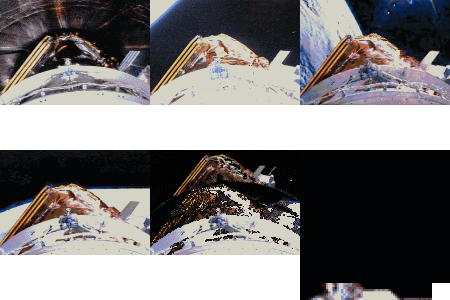 Swift RocketCam
24.12.2004
A forward-facing RocketCam (TM) mounted inside the payload fairing of a Delta II rocket captured these dramatic video frames on November 20th -- as the Swift satellite observatory journeyed to an orbit 600 kilometers above planet Earth. Some frames were interpolated to correct for transmission problems.
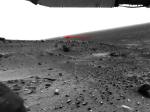 A Dust Devil Swirling on Mars
23.03.2005
What is that wisp on the horizon? Scientists think that the slight white apparition is actually a Martian dust devil that was caught swirling across Mars. The above image was taken earlier this month by the robotic rover Spirit.
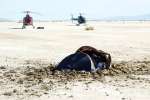 Genesis Missions Hard Impact
5.07.2009
A flying saucer from outer space crash-landed in the Utah desert in 2004 after being tracked by radar and chased by helicopters. No space aliens were involved, however. The saucer, pictured above, was the Genesis sample return capsule, part of a human-made robot Genesis spaceship launched in 2001 by NASA itself to study the Sun.
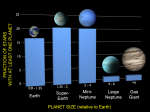 Ten Billion Earths
12.01.2013
How common are Earth-sized planets? Quite common, according to extrapolations from new data taken by NASA's orbiting Kepler spacecraft. Current computer models are indicating that at least one in ten stars are orbited by an Earth-sized planet, making our Milky Way Galaxy the home to over ten billion Earths.
|
January February March April May June July August September October |
|||||||||||||||||||||||||||||||||||||||||||||||||