
|
You entered: NASA
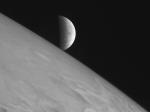 Europa Rising
7.05.2007
When passing Jupiter on your way to Pluto, what should you look for? NASA pondered just this question recently, and the response from one space enthusiast was to capture the above breathtaking moonrise.
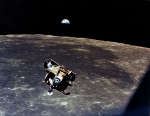 From the Moon to the Earth
19.07.2009
After the most famous voyage of modern times, it was time to go home. After proving that humanity has the ability to go beyond the confines of planet Earth, the first humans to walk...
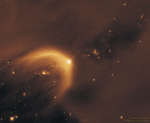 LDN 1471: A Windblown Star Cavity
6.05.2020
What is the cause of this unusual parabolic structure? This illuminated cavity, known as LDN 1471, was created by a newly forming star, seen as the bright source at the peak of the parabola.
 APOD: 2025 December 3 Б Visualization: Near a Black Hole and Disk
3.12.2025
What would it look like to plunge into a monster black hole? This image from a supercomputer visualization shows the entire sky as seen from a simulated camera plunging toward a 4-million-solar-mass black hole, similar to the one at the center of our galaxy.
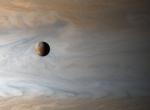 Io: Moon Over Jupiter
20.04.2001
How big is the Jovian moon Io? The most volcanic body in the Solar System, Io (usually pronounced "EYE-oh") is 3,600 kilometers in diameter, about the size of planet Earth's single large natural satellite.
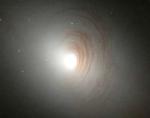 NGC 2787: A Barred Lenticular Galaxy
8.04.2002
Lenticular galaxies aren't supposed to be photogenic. Like spiral galaxies, they contain a disk, but like elliptical galaxies, they are usually short on dust, gas, and pretty spiral arms. Lenticulars are relatively little studied, possibly because of their seemingly benign nature. Famous galaxies historically classified as lenticular include M84, M85, and M86.
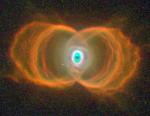 MyCn18: An Hourglass Nebula
15.06.2002
The sands of time are running out for the central star of this hourglass-shaped planetary nebula. With its nuclear fuel exhausted, this brief, spectacular, closing phase of a Sun-like star's life occurs as its outer layers are ejected - its core becoming a cooling, fading white dwarf.
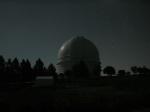 Palomar at Night
7.08.2003
What's wrong with this picture? The summer night sky is clear, and moonlight illuminates the dome of the Hale 200-inch Telescope at Palomar Observatory, northeast of San Diego, California, USA. The familiar stars of the Teapot asterism in the constellation Sagittarius shine above the dome and to the right.
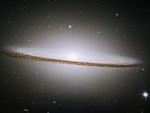 The Sombrero Galaxy from HST
8.10.2003
Why does the Sombrero Galaxy look like a hat? Reasons include the Sombrero's unusually large and extended central bulge of stars, and dark prominent dust lanes that appear in a disk that we see nearly edge-on. Billions of old stars cause the diffuse glow of the extended central bulge.
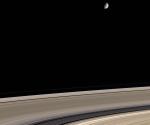 Saturn: Dirty Rings and a Clean Moon
6.06.2005
Eating surface ice from Enceladus might be healthier than eating ice from Saturn's rings -- it certainly appears cleaner. From their apparent densities and reflectance properties, both the rings of Saturn and its shiniest moon, Enceladus, are thought to be composed predominantly of water ice.
|
January February March April May June July August September October |
|||||||||||||||||||||||||||||||||||||||||||||||||