
|
You entered: NASA
 Hubble Resolves Expiration Date For Green Cheese Moon
1.04.2002
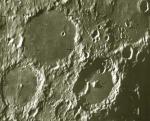
Using the new camera on the recently refitted Hubble Space Telescope, astronomers have been able to confirm that the Moon is made of green cheese. The telling clue was the resolution of a numeric date after which the Moon may go bad.
 Star-Forming Region RCW38 from 2MASS
17.07.2002
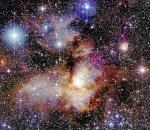
The star cluster in RCW38 was hiding. Looking at the star forming region RCW38 will not normally reveal most of the stars in this cluster. The reason is that the open cluster is so young that it is still shrouded in thick dust that absorbs visible light.
 Apollo 17: Last on the Moon
12.12.2002
In December of 1972, Apollo 17 astronauts Eugene Cernan and Harrison Schmitt spent about 75 hours on the Moon, in the Taurus-Littrow valley, while colleague Ronald Evans orbited overhead. Near the beginning of their...
 The Galactic Center in Infrared
7.09.2003
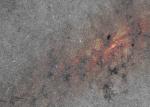
The center of our Galaxy is a busy place. In visible light, much of the Galactic Center is obscured by opaque dust. In infrared light, however, dust glows more and obscures less, allowing nearly one million stars to be recorded in the above photograph.
 Close up of the Face on Mars
14.12.2003
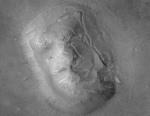
Wouldn't it be fun if clouds were turtles? Wouldn't it be fun if the laundry on the bedroom chair was a friendly monster? Wouldn't it be fun if rock mesas on Mars were faces or interplanetary monuments? Clouds, though, are small water droplets, floating on air.
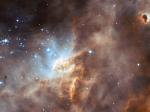 N11B: Star Cloud of the LMC
7.07.2004
Massive stars, abrasive winds, mountains of dust, and energetic light sculpt one of the largest and most picturesque regions of star formation in the Local Group of Galaxies. Known as N11, the region...
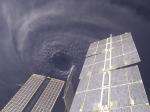 Above the Eye of Hurricane Ivan
15.09.2004
Ninety percent of the houses on Grenada were damaged. Such is the destructive force of Hurricane Ivan, already one of the most powerful and destructive hurricanes on record. And the storm will likely make landfall in southern USA tomorrow.
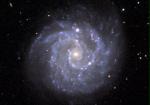 Gangly Spiral Galaxy NGC 3184
20.09.2000
NGC 3184 is a large spiral galaxy with a small nucleus and long sprawling spiral arms. Although NGC 3184 contains hundreds of billions of stars, the blue color of its spiral arms comes mostly from relatively few bright young blue stars.
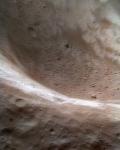 The Regolith of Asteroid Eros
3.03.2002
From fifty kilometers above asteroid Eros, the surface inside one of its largest craters appears covered with an unusual substance: regolith. The thickness and composition of the surface dust that is regolith remains a topic of much research.
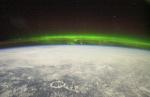 Aurora from Space
8.04.2003
What do auroras look like from space? From the ground, auroras dance high above clouds, frequently causing spectacular displays. The International Space Station (ISS) orbits just at the same height as many auroras, though. Therefore, sometimes it flies over them, but also sometimes it flies right through.
|
January February March April May June July August September October |
|||||||||||||||||||||||||||||||||||||||||||||||||