
|
You entered: NASA
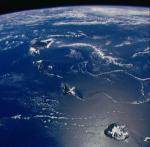 Hawaii
2.03.1997
Aloha! With the graceful arc of the Earth's limb in the background, the entire Hawaiian Island archipelago is visible in this stunning photo taken by the astronauts onboard the shuttle Discovery in October of 1988. Along with popular beaches and tropical resorts, these volcanic islands offer extreme elevations with dark, dry, cloudless skies.
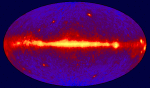 The Gamma Ray Sky
21.03.1998
What if you could "see" gamma rays? If you could, the sky would seem to be filled with a shimmering high-energy glow from the most exotic and mysterious objects in the Universe.
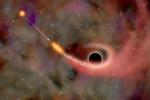 X Rays Indicate Star Ripped Up by Black Hole
24.02.2004
What could rip a star apart? A black hole. Giant black holes in just the right mass range would pull on the front of a closely passing star much more strongly than on the back.
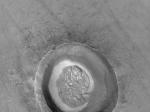 Brain Crater on Mars
19.05.2004
What caused this unusual looking crater floor on Mars? Appearing at first glance to resemble the human brain, the natural phenomena that created the unusual texture on the floor of this Martian impact crater are currently under investigation. The light colored region surrounding the brain-textured region is likely sand dunes sculpted by winds.
 The Equal Night
20.03.2005
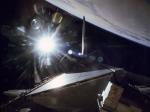
Today, the Sun crosses the celestial equator heading north, marking the Vernal Equinox -- the first day of spring in the Northern Hemisphere and autumn in the south. Equinox means equal night and with the Sun on the celestial equator, Earthlings will experience 12 hours of daylight and 12 hours of darkness.
 Deep Impact Spacecraft Hurtles Toward Comet
16.05.2005
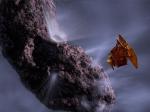
What happens when you crash into a comet? That was a question considered by astronomers when they designed the Deep Impact mission, launched in January. This coming July 4, the Deep Impact spaceship will reach its target - Comet Tempel 1 -- and release an impactor over five times the mass of a person toward its surface.
 Earth at Twilight
11.06.2005
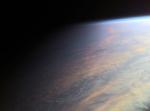
No sudden, sharp boundary marks the passage of day into night in this gorgeous view of ocean and clouds over our fair planet Earth. Instead, the shadow line or terminator is diffuse and shows the gradual transition to darkness we experience as twilight.
 Coronet in the Southern Crown
21.09.2007
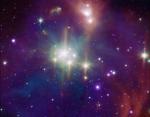
X-rays from young stars and infrared light from stars and cosmic dust are combined in this false color image of a star-forming region in Corona Australis, the Southern Crown. The small star grouping is fittingly known as the Coronet Cluster.
 To Fly Free in Space
1.01.2012
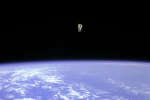
At about 100 meters from the cargo bay of the space shuttle Challenger, Bruce McCandless II was farther out than anyone had ever been before. Guided by a Manned Maneuvering Unit (MMU), astronaut McCandless, pictured above, was floating free in space.
 To Fly Free in Space
31.12.2017
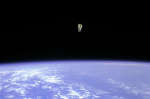
What would it be like to fly free in space? At about 100 meters from the cargo bay of the space shuttle Challenger, Bruce McCandless II was living the dream -- floating farther out than anyone had ever been before. Guided by a Manned Maneuvering Unit (MMU), astronaut McCandless, pictured, was floating free in space.
|
January February March April May June July August September October |
|||||||||||||||||||||||||||||||||||||||||||||||||