
|
You entered: NASA
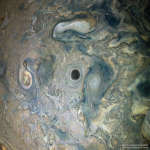 Jupiter Abyss
10.06.2019
What's that black spot on Jupiter? No one is sure. During the latest pass of NASA's Juno around Jupiter, the robotic spacecraft imaged an usually dark cloud feature informally dubbed the Abyss. Surrounding cloud patterns show the Abyss to be at the center of a vortex.
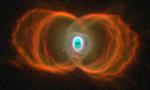 MyCn18: An Hourglass Nebula
4.06.2000
The sands of time are running out for the central star of this hourglass-shaped planetary nebula. With its nuclear fuel exhausted, this brief, spectacular, closing phase of a Sun-like star's life occurs as its outer layers are ejected - its core becoming a cooling, fading White Dwarf.
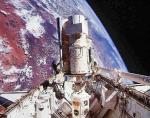 Astro 2 In Orbit
17.03.2001
Six years ago, a cluster of three ultraviolet telescopes flew into orbit on the Astro-2 mission aboard the space shuttle Endeavour. Seen here perched in Endeavour's payload bay about 350 kilometers above the Australian desert are the Hopkins Ultraviolet Telescope (HUT), the Ultraviolet Imaging Telescope (UIT), and the Wisconsin Ultraviolet Photo-Polarimeter Experiment (WUPPE).
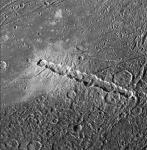 Ganymede: Torn Comet Crater Chain
15.12.2001
This striking line of 13 closely spaced craters on Jupiter's moon Ganymede was photographed by the Galileo spacecraft in 1997. The picture covers an area about 120 miles wide and the chain of craters cuts across a sharp boundary between dark and light terrain. What caused this crater chain?
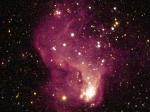 Star Forming Region Hubble V
25.12.2001
How did stars form in the early universe? Astronomers are gaining insight by studying NGC 6822, a nearby galaxy classified as irregular by modern standards but appearing more typical of galaxies billions of years ago. Inspection of NGC 6822 shows several bright star groups, including two dubbed Hubble-X and Hubble-V.
 Earth at Night
22.08.2004
This is what the Earth looks like at night. Can you find your favorite country or city? Surprisingly, city lights make this task quite possible. Human-made lights highlight particularly developed or populated areas of the Earth's surface, including the seaboards of Europe, the eastern United States, and Japan.
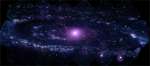 Ultraviolet Andromeda
27.10.2010
This stunning vista represents the highest resolution image ever made of the Andromeda Galaxy (aka M31) at ultraviolet wavelengths. Recorded by NASA's Swift satellite, the mosaic is composed of 330 individual images covering a region 200,000 light-years wide.
 Odyssey Over Mars
22.03.2002
Scroll right and journey for 300 kilometers over Terra Sirenum in the cratered highlands of southern Mars. The infrared view, 32 kilometers wide, was recently recorded by the THEMIS camera on board the orbiting Mars Odyssey spacecraft.
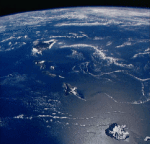 Hawaii
16.12.1995
Aloha! With the graceful arc of the Earth's limb in the background, the entire Hawaiian Island archipelago is visible in this stunning photo taken by the astronauts onboard the shuttle Discovery in October of 1988. Along with popular beaches and tropical resorts, these volcanic islands offer extreme elevations with dark, dry, cloudless skies.
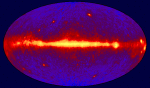 The Gamma Ray Sky
22.02.1997
What if you could "see" gamma rays? If you could, the sky would seem to be filled with a shimmering high-energy glow from the most exotic and mysterious objects in the Universe.
|
January February March April May June July August September October |
|||||||||||||||||||||||||||||||||||||||||||||||||