
|
You entered: NASA
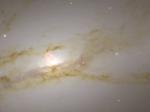 A Bubbling Galaxy Center
12.06.2000
What's happening in the center of this galaxy? Close inspection of the center of NGC 4438, as visible in this recently released representative-color image by the Hubble Space Telescope, reveals an unusual bubble of hot gas, colored in red.
 In Chandor Chasma on Mars
31.05.2002
Scroll right and dive into a spectacular canyon on Mars. This daytime infrared view, recently recorded by the THEMIS camera on board the orbiting Mars Odyssey spacecraft, covers a 30 by 175 kilometer swath running along the canyon floor.
 Earth at Night
10.08.2002
This is what the Earth looks like at night. Can you find your favorite country or city? Surprisingly, city lights make this task quite possible. Human-made lights highlight particularly developed or populated areas of the Earth's surface, including the seaboards of Europe, the eastern United States, and Japan.
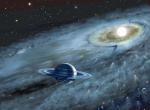 Fomalhaut Dust Disk Indicates Planets
11.10.2002
One of the brightest stars on the sky likely has planets. Fomalhaut, actually the 17th brightest star in the night sky, is a mere 22 light-years away but only a fraction of the age of our Sun.
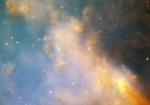 Dumbbell Nebula Close Up from Hubble
11.02.2003
What causes unusual knots of gas and dust in planetary nebulas? Seen previously in the Ring Nebula, the Helix Nebula, and the Eskimo Nebula, the knots' existence was not predicted previously and still not well understood.
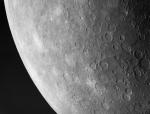 Southwest Mercury
16.02.2003
The planet Mercury resembles a moon. Mercury's old surface is heavily cratered like many moons. Mercury is larger than most moons but smaller than Jupiter's moon Ganymede and Saturn's moon Titan. Mercury is much denser and more massive than any moon, though, because it is made mostly of iron.
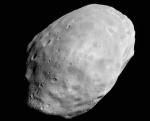 Martian Moon Phobos from MGS
1.07.2003
Why is Phobos so dark? Phobos, the largest and innermost of two Martian moons, is the darkest moon in the entire Solar System. Its unusual orbit and color indicate that it may be a captured asteroid composed of a mixture of ice and dark rock.
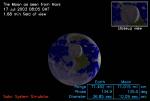 Mars Simulated View
16.07.2003
When earthdweller Patrick Vantuyne wondered what his home planet's single large moon would look like if viewed from Mars on July 17, he availed himself of the JPL Solar System Simulator. Of course...
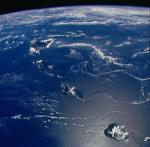 Hawaii
25.07.1998
Aloha! With the graceful arc of the Earth's limb in the background, the Hawaiian Island archipelago is visible in this stunning photo taken by the astronauts onboard the shuttle Discovery in October of 1988. Along with popular beaches and tropical resorts, these volcanic islands offer extreme elevations with dark, dry, cloudless skies.
 Opportunity s Horizon
4.02.2004
Remarkably, the Opportunity Mars rover lies in a small martian impact crater about 3 meters deep and 22 meters wide. For 360 degrees, Opportunity's horizon stretches to the right in this new color mosaic image from the rover's panoramic camera.
|
January February March April May June July August September October |
|||||||||||||||||||||||||||||||||||||||||||||||||