
|
You entered: color
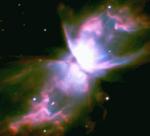 NGC 6302: The Butterfly Nebula
2.06.1998
The Butterfly Nebula is only thousands of years old. As a central star of a binary system aged, it threw off its outer envelopes of gas in a strong stellar wind. The remaining stellar core is so hot it ionizes the previously ejected gas, causing it to glow.
 Twilight in a Flower
6.05.2023
Transformed into the petals of a flower, 16 exposures show the passage of day into night in this creative timelapse skyscape. Start at the top and move counterclockwise to follow consecutive moments as the twilight sky turns an ever darker blue and night blossoms.
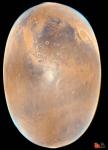 A Mars Glint
8.06.1998
If aligned just right, even a planet can produce a glint. The above combined pictures of Mars make the red planet appear unusually elongated - Mars is really almost spherical. However, these pictures were taken when the Sun was nearly directly behind the Mars Global Surveyor (MGS) spacecraft.
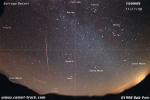 An Annotated Leonid
11.11.2001
The 1998 Leonids Meteor Shower was one of the most photographed meteor event in history. Patient observers saw bright meteors streak across dark skies every few minutes, frequently leaving fading trails stretching across the sky. High above the Anza-Borrego Desert, a meteor was photographed streaking up from the radiant constellation of the Leonids: Leo.
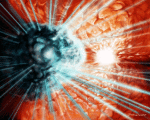 Lasers in Eta Carinae
11.01.1996
Have you heard about the great LASER light show in the sky? Well, nobody had until it was announced just yesterday by a team led by K. Davidson (U. Minnesota) and S. Johansson (U. Lund).
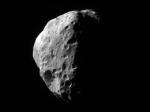 Epimetheus: A Small Moon of Saturn
24.08.2005
How did Epimetheus form? No one is yet sure. To help answer that question, this small moon has recently been imaged again in great detail by the robot spacecraft Cassini now orbiting Saturn. Epimetheus sometimes orbits Saturn in front of Janus, another small satellite, but sometimes behind.
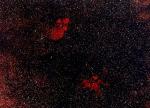 The Cat's Paw Nebula
7.12.1999
As soon as we find out whose cat did this . . . Nebulae are as famous for being identified with familiar shapes as perhaps cats are for getting into trouble. No cat, though, could have created the vast Cat's Paw Nebula visible in Scorpius.
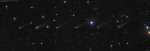 Rosetta and Comet Outbound
28.11.2015
Not a bright comet, 67P/Churyumov-Gerasimenko now sweeps slowly through planet Earth's predawn skies near the line-up of planets along the ecliptic. Still, this composite of telescopic images follows the comet's progress as it moves away from the Sun beyond the orbit of Mars, from late September (left) through late November (far right).
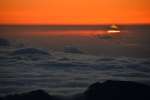 A Green Flash of Spring
9.04.2016
Taken on March 20 from the top of Haleakala on the isle of Maui, planet Earth, the first sunrise of northern spring is pictured in this vacation snapshot. The telephoto view from the volcanic caldera above a sea of clouds also captures an elusive green flash near the Sun's upper limb.
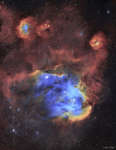 IC 2944: The Running Chicken Nebula
20.04.2020
To some, it looks like a giant chicken running across the sky. To others, it looks like a gaseous nebula where star formation takes place. Cataloged as IC 2944, the Running Chicken Nebula spans about 100 light years and lies about 6,000 light years away toward the constellation of the Centaur (Centaurus).
|
January February March April May June July August September October |
|||||||||||||||||||||||||||||||||||||||||||||||||