
|
You entered: color
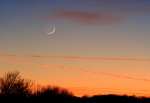 Mercury Chases the Sunset
12.01.2008
This colorful view of the western sky at sunset features last Wednesday's slender crescent Moon. Of course, when the Moon is in its crescent phase it can never be far from Sun in the sky.
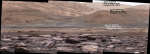 Curiosity Surveys Lower Mount Sharp on Mars
28.12.2016
If you could stand on Mars -- what might you see? If you were the Curiosity rover, then just last month you would have contemplated the featured image -- a breathtaking panorama of the lower portion of Mount Sharp. The colors have been adjusted to mimic lighting familiar to Earthlings.
 NGC 2440: Cocoon of a New White Dwarf
11.01.2004
Like a butterfly, a white dwarf star begins its life by casting off a cocoon that enclosed its former self. In this analogy, however, the Sun would be a caterpillar and the ejected shell of gas would become the prettiest of all!
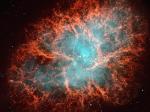 M1: The Crab Nebula from NOT
20.09.2005
This is the mess that is left when a star explodes. The Crab Nebula, the result of a supernova seen in 1054 AD, is filled with mysterious filaments. The filaments are not only tremendously...
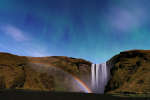 Waterfall, Moonbow, and Aurora from Iceland
14.11.2011
The longer you look at this image, the more you see. Perhaps your eye is first drawn to the picturesque waterfall called Skogarfoss visible on the image right. Just as prevalent, however, in this Icelandic visual extravaganza, is the colorful arc of light on the left.
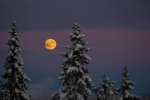 The Wolf s Moon
20.01.2012
A Full Moon rising can be a dramatic celestial sight, and Full Moons can have many names. Captured on January 8 from Ötersund, Sweden, this evocative moonrise portrait might make you feel the cold of winter in the north.
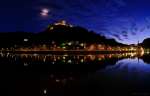 Lunar Corona over Cochem Castle
25.05.2013
This bat-like apparition does not shine on clouds passing over Gotham city. Instead, the cloud bank in silhouette against a colorful lunar corona was spotted on the evening of May 18 over Cochem, Germany from the banks of the river Mossele.
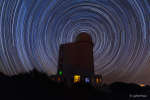 Circumpolar Star Trails
18.01.2019
As Earth spins on its axis, the stars appear to rotate around an observatory in this well-composed image from the Canary Island of Tenerife. Of course, the colorful concentric arcs traced out by the stars are really centered on the planet's North Celestial Pole.
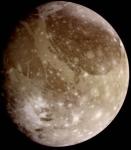 Ganymede: The Largest Moon in the Solar System
20.06.2000
If Ganymede orbited the Sun, it would be considered a planet. The reason is that Jupiter's moon Ganymede is not only the largest moon in the Solar System, it is larger than planets Mercury and Pluto.
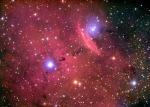 Emission and Reflection in NGC 6559
23.10.2001
Bright gas and dark dust permeate the space between stars in a nebula known as NGC 6559. The gas, primarily hydrogen, is responsible for the diffuse red glow of the emission nebula. As energetic...
|
January February March April May June July August September October |
|||||||||||||||||||||||||||||||||||||||||||||||||