
|
You entered: color
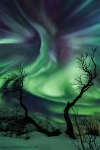 Creature Aurora Over Norway
18.11.2018
It was Halloween and the sky looked like a creature. Exactly which creature, the astrophotographer was unsure but (possibly you can suggest one). Exactly what caused this eerie apparition in 2013 was sure: one of the best auroral displays in recent years. This spectacular aurora had an unusually high degree of detail.
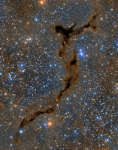 Dark Seahorse in Cepheus
24.10.2019
Light-years across, this suggestive shape known as the Seahorse Nebula appears in silhouette against a rich, luminous background of stars. Seen toward the royal northern constellation of Cepheus, the dusty, obscuring clouds are part of a Milky Way molecular cloud some 1,200 light-years distant.
 The Dark Seahorse in Cepheus
5.11.2021
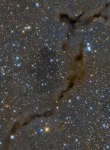
Light-years across, this suggestive shape known as the Seahorse Nebula appears in silhouette against a rich, luminous background of stars. Seen toward the royal northern constellation of Cepheus, the dusty, obscuring clouds are part of a Milky Way molecular cloud some 1,200 light-years distant.
 The Dark Seahorse in Cepheus
20.04.2023
Spanning light-years, this suggestive shape known as the Seahorse Nebula appears in silhouette against a rich, luminous background of stars. Seen toward the royal northern constellation of Cepheus, the dusty, obscuring clouds are part of a Milky Way molecular cloud some 1,200 light-years distant.
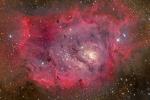 The Lagoon Nebula in Gas, Dust, and Stars
16.07.2007
Stars are battling gas and dust in the Lagoon Nebula but the photographers are winning. Also known as M8, this photogenic nebula is visible even without binoculars towards the constellation of Sagittarius. The energetic processes of star formation create not only the colors but the chaos.
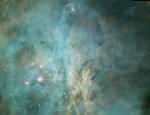 In the Center of the Trapezium
10.07.2005
Start with the constellation of Orion. Near Orion's belt is a fuzzy area known as the Great Nebula of Orion or M42. In this nebula is a bright star cluster known as the Trapezium, shown above. New stellar systems are forming there in gigantic globs of gas and dust known as Proplyds.
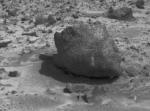 Yogi Rock
11.07.1997
This portrait of Yogi Rock, a now famous boulder on Mars, was recorded on Sol 3 by the Imager for Mars Pathfinder (IMP). Big and friendly looking like its Earth cartoon namesake Yogi Bear, Yogi Rock is a prominent visible feature at the Pathfinder landing site.
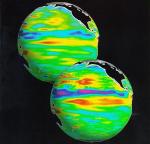 El Nino Water Rhythm
13.01.1998
This year's El Niño is the strongest ever recorded. The large amount of warm water in the Pacific Ocean near the equator is causing unusual weather all over planet Earth.
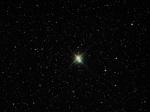 Albireo: A Bright and Beautiful Double
30.08.2005
Sometimes, even a small telescope can help unlock a hidden beauty of the heavens. Such is the case of the bright double star Albireo. Seen at even slight magnification, Albireo unfolds from a bright single point into a beautiful double star of strikingly different colors.
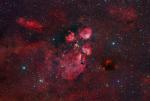 The Cats Paw Nebula
28.06.2006
Nebulae are perhaps as famous for being identified with familiar shapes as perhaps cats are for getting into trouble. Still, no known cat could have created the vast Cat's Paw Nebula visible in Scorpius.
|
January February March April May June July August September October |
|||||||||||||||||||||||||||||||||||||||||||||||||