
|
You entered: color
 Fireworks vs Supermoon
6.07.2023
On July 4, an almost Full Moon rose in planet Earth's evening skies. Also known as a Buck Moon, the full lunar phase (full on July 3 at 11:39 UTC) was near perigee, the closest point in the Moon's almost monthly orbit around planet Earth.
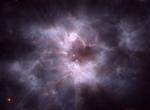 NGC 2440: Cocoon of a New White Dwarf
30.07.2000
Like a butterfly, a white dwarf star begins its life by casting off a cocoon that enclosed its former self. In this analogy, however, the Sun would be a caterpillar and the ejected shell of gas would become the prettiest of all!
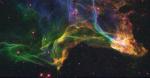 The Cygnus Loop
23.06.2001
The shockwave from a 20,000 year-old supernova in the constellation of Cygnus supernova explosion is still expanding into interstellar space. The collision of this fast moving wall of gas with a stationary cloud...
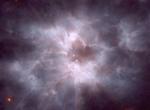 NGC 2440: Cocoon of a New White Dwarf
5.08.2001
Like a butterfly, a white dwarf star begins its life by casting off a cocoon that enclosed its former self. In this analogy, however, the Sun would be a caterpillar and the ejected shell of gas would become the prettiest of all!
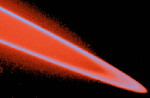 Jupiter's Rings
2.08.1995
Astronomers using NASA's Voyager spacecraft to search for a ring system around Jupiter discovered these faint rings in 1979. Unlike Saturn's bright rings which are composed of chunks of rock and ice, Jupiter's rings appear to consist of fine particles of dust.
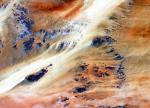 Terkezi Oasis in the Sahara Desert
12.11.2002
Dominating the top third of Africa is the largest band of dry land on Earth: the Sahara Desert. Stretching across the Sahara are vast planes of sand and gravel, seas of sand dunes, and barren rocky mountains.
 Olympus Mons From Orbit
19.10.1998
Olympus Mons on Mars is the largest volcano in the Solar System. Although three times higher than Earth's Mount Everest, Olympus Mons would not be difficult to climb because of the volcano's great breadth.
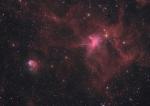 The Spider and The Fly
27.10.2006
Star clusters and nebulae abound in the ancient northern constellation Auriga - a region that includes the interesting pair NGC 1931 (lower left) and IC 417. In this gorgeous color image, an imaginative eye toward the expansive IC 417 and diminutive NGC 1931 suggests a cosmic spider and fly.
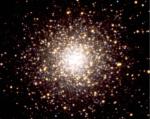 M3: Half A Million Stars
17.09.1999
This immense ball of half a million stars older than the sun lies 30,000 light-years above the plane of our Galaxy. Cataloged as M3 (and NGC 5272), it is one of about 250 globular star clusters which roam our galactic halo.
 A Retreating Thunderstorm at Sunset
28.08.2013
What type of cloud is that? This retreating cumulonimbus cloud, more commonly called a thundercloud, is somewhat unusual as it contains the unusual bumpiness of a mammatus cloud on the near end, while simultaneously producing falling rain on the far end.
|
January February March April May June July August September October |
|||||||||||||||||||||||||||||||||||||||||||||||||