
|
You entered: light
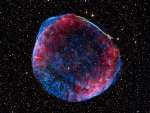 SN 1006 Supernova Remnant
12.07.2014
A new star, likely the brightest supernova in recorded human history, lit up planet Earth's sky in the year 1006 AD. The expanding debris cloud from the stellar explosion, found in the southerly constellation of Lupus, still puts on a cosmic light show across the electromagnetic spectrum.
 Globular Cluster M15
10.12.2001
Stars, like bees, swarm around the center of bright globular cluster M15. This ball of over 100,000 stars is a relic from the early years of our Galaxy, and continues to orbit the Milky Way's center.
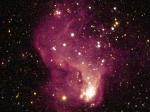 Star Forming Region Hubble V
25.12.2001
How did stars form in the early universe? Astronomers are gaining insight by studying NGC 6822, a nearby galaxy classified as irregular by modern standards but appearing more typical of galaxies billions of years ago. Inspection of NGC 6822 shows several bright star groups, including two dubbed Hubble-X and Hubble-V.
 Ice Fishing for Cosmic Neutrinos
3.08.2003
Scientists are melting holes in the bottom of the world. In fact, several holes have been melted near the South Pole, and they are now being used as astronomical observatories. Astronomers with the Antarctic Muon and Neutrino Detector Array (AMANDA) lower into each vertical lake a string knotted with basketball-sized light detectors.
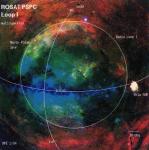 Loop I in the Northern Sky
3.05.1999
One of the largest coherent structures on the sky is known simply as Loop I and can best be seen in radio and X-ray maps. Spanning over 100 degrees, part of Loop I appears so prominent in northern sky maps that it is known as the North Polar Spur (NPS).
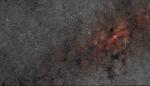 The Galactic Center in Infrared
21.06.1999
The center of our Galaxy is a busy place. In visible light, much of the Galactic Center is obscured by opaque dust. In infrared light, however, dust glows more and obscures less, allowing nearly one million stars to be recorded in the above photograph.
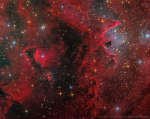 IC 1871: Inside the Soul Nebula
28.11.2018
This cosmic close-up looks deep inside the Soul Nebula. The dark and brooding dust clouds on the left, outlined by bright ridges of glowing gas, are cataloged as IC 1871. About 25 light-years across, the telescopic field of view spans only a small part of the much larger Heart and Soul nebulae.
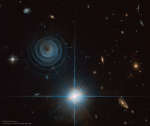 The Extraordinary Spiral in LL Pegasi
29.11.2021
What created the strange spiral structure on the upper left? No one is sure, although it is likely related to a star in a binary star system entering the planetary nebula phase, when its outer atmosphere is ejected.
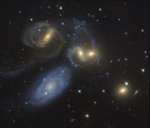 Stephan s Quintet
25.02.2012
The first identified compact galaxy group, Stephan's Quintet is featured in this eye-catching image constructed with data drawn from the extensive Hubble Legacy Archive. About 300 million light-years away, only four of these five galaxies are actually locked in a cosmic dance of repeated close encounters.
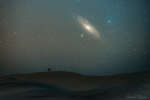 Andromeda over Patagonia
25.11.2020
How far can you see? The Andromeda Galaxy at 2.5 million light years away is the most distant object easily seen with your unaided eye. Most other apparent denizens of the night sky -- stars...
|
January February March April May June July August September October |
|||||||||||||||||||||||||||||||||||||||||||||||||