
|
You entered: light
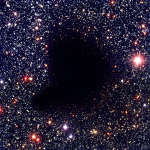 APOD: 2023 January 29 Б Barnard 68: Dark Molecular Cloud
29.01.2023
Where did all the stars go? What used to be considered a hole in the sky is now known to astronomers as a dark molecular cloud. Here, a high concentration of dust and molecular gas absorb practically all the visible light emitted from background stars.
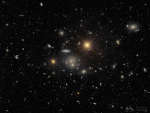 The Hydra Cluster of Galaxies
16.02.2023
Once upon a midnight dreary, while I pondered weak and weary, O'er volumes of astronomy and forgotten lore, I stumbled upon this snapshot, cosmic and eerie, A sight that filled my heart with awe and more.
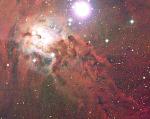 The Fox Fur Nebula
1.07.2002
The nebula surrounding bright star S Mon is filled with dark dust and glowing gas. The strange shapes that surrounding this star originate from fine interstellar dust reacting in complex ways with the energetic light and hot gas being expelled by the young stars.
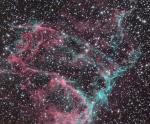 IC1340 in the Eastern Veil
26.09.2003
These ghostly filaments of interstellar gas are just a small part of the expansive Veil Nebula, seen against a rich field of background stars in the long-necked constellation Cygnus. Also known as the Cygnus...
 Rubin's Galaxy
18.09.2021
In this Hubble Space Telescope image the bright, spiky stars lie in the foreground toward the heroic northern constellation Perseus and well within our own Milky Way galaxy. In sharp focus beyond is UGC 2885, a giant spiral galaxy about 232 million light-years distant.
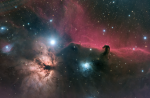 Horsehead and Flame
29.12.2022
The Horsehead Nebula, famous celestial dark marking also known as Barnard 33, is notched against a background glow of emission nebulae in this sharp cosmic skyscape. About five light-years "tall" the Horsehead lies some 1,500 light-years away in the constellation of Orion.
 Rubin s Galaxy
5.04.2023
In this Hubble Space Telescope image the bright, spiky stars lie in the foreground toward the heroic northern constellation Perseus and well within our own Milky Way galaxy. In sharp focus beyond is UGC 2885, a giant spiral galaxy about 232 million light-years distant.
 Galactic Cirrus: Mandel Wilson 9
21.07.2023
The combined light of stars along the Milky Way are reflected by these cosmic dust clouds that soar 300 light-years or so above the plane of our galaxy. Known to some as integrated flux nebulae and commonly found at high galactic latitudes, the dusty galactic cirrus clouds are faint.
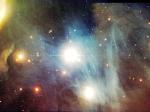 A Chamaeleon Sky
9.06.2002
A photogenic group of nebulae can be found toward Chamaeleon, a constellation visible predominantly in skies south of the Earth's equator. Celestial objects visible there include the blue reflection nebulas highlighted by thin dust surrounding the bright stars in the above image center.
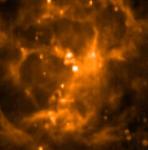 Infrared Trifid
28.08.1997
The Trifid nebula (M20) is a bright star forming region in Sagittarius, 5000 light years from Earth. In visible light, the interstellar gas cloud is crossed by dark, obscuring dust lanes which roughly divide the glowing emission nebula into three major parts.
|
January February March April May June July August September October |
|||||||||||||||||||||||||||||||||||||||||||||||||