
|
You entered: light
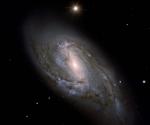 Dusty Spiral M66
2.09.2006
When morning twilight came to the Paranal Observatory in Chile, astronomers Mark Neeser and Peter Barthel interrupted their search for faint quasars, billions of light-years away. And just for a moment, they used Very Large Telescopes at the European Southern Observatory to appreciate the beauty of the nearby Universe.
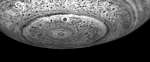 Beneath the South Pole of Saturn
27.10.2008
What clouds lurk beneath Saturn's unusual South Pole? To help find out, the robotic Cassini spacecraft currently orbiting Saturn imaged the nether region of the gigantic ringed orb in infrared light. There thick...
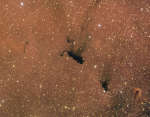 Molecular Cloud Barnard 163
1.05.2011
It may look to some like a duck, but it lays stars instead of eggs. In the center of the above image lies Barnard 163, a nebula of molecular gas and dust so thick that visible light can't shine through it.
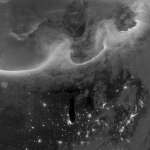 Aurorae over Planet Earth
11.10.2012
North America at night is easy to recognize in this view of our fair planet from orbit, acquired by the Suomi-NPP satellite on October 8. The spectacular waves of visible light emission rolling above the Canadian provinces of Quebec and Ontario in the upper half of the frame are the Aurora Borealis or northern lights.
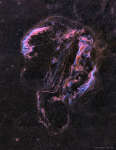 The Ghostly Veil Nebula
31.10.2019
A ghostly visage on a cosmic scale, these remains of shocked, glowing gas haunt planet Earth's sky toward the constellation of Cygnus and form the Veil Nebula. The nebula itself is a large supernova remnant, an expanding cloud born of the death explosion of a massive star.
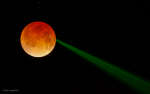 Red Moon, Green Beam
18.04.2014
This is not a scene from a sci-fi special effects movie. The green beam of light and red lunar disk are real enough, captured in the early morning hours of April 15. Of course, the reddened lunar disk is easy to explain as the image was taken during this week's total lunar eclipse.
 High Energy Stereoscopic System II
27.07.2012
The largest of its kind, the High Energy Stereoscopic System (H.E.S.S.) II telescope stands in the foreground of this photo. Tilted horizontally it reflects the inverted landscape of the Namibian desert in a segmented mirror 24 meters wide and 32 meters tall, equal in area to two tennis courts.
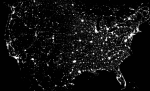 The United States At Night
8.07.2000
This is what the United States of America looks like at night! Can you find your favorite US city in this image? Surprisingly, city lights make this task quite possible. The above picture is actually a composite of over 200 images made by satellites orbiting planet Earth.
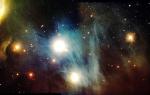 A Chamaeleon Sky
23.03.1999
A photogenic group of nebulae can be found in Chamaeleon, a constellation visible predominantly in skies south of the Earth's equator. Towards Chamaeleon, dark molecular clouds and bright planetary nebula NGC 3195 can be found. Visible near the center of the above photograph is a reflection nebula surrounding a young bright star.
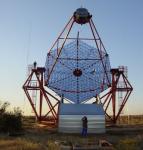 HESS Gamma Ray Telescope
6.09.2002
Most ground-based telescopes with lenses and mirrors are hindered by the Earth's nurturing, protective atmosphere that blurs images and scatters and absorbs light. But this telescope was designed to detect extreme gamma rays - photons with over 100 billion times the energy of visible light - and actually requires the atmosphere to operate.
|
January February March April May June July August September October |
|||||||||||||||||||||||||||||||||||||||||||||||||