
|
You entered: light
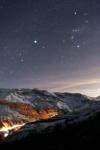 Alborz Mountains in Moonlight
2.02.2007
On January 25th, light from a first quarter Moon illuminated this dreamlike landscape looking across the rugged, snow-covered peaks of the Alborz Mountain Range in northern Iran. The stunning sky is filled with stars, including the yellow-tinged Betelgeuse at the shoulder of Orion.
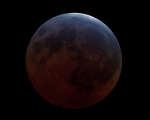 Full Moon in Earth's Shadow
7.04.2015
Last week the Full Moon was completely immersed in Earth's dark umbral shadow, just briefly though. The total phase of the April 4, 2015 lunar eclipse lasted less than 5 minutes, the shortest total lunar eclipse of the century.
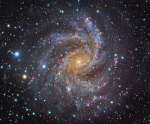 Facing NGC 6946
23.02.2018
From our vantage point in the Milky Way Galaxy, we see NGC 6946 face-on. The big, beautiful spiral galaxy is located just 10 million light-years away, behind a veil of foreground dust and stars in the high and far-off constellation of Cepheus.
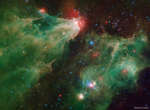 The Cave Nebula in Infrared from Spitzer
10.06.2019
What's happening in and around the Cave Nebula? To help find out, NASA's orbiting Spitzer Space Telescope looked into this optically-dark star-forming region in four colors of infrared light. The Cave Nebula...
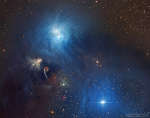 Stars and Dust in Corona Australis
11.01.2020
Cosmic dust clouds and young, energetic stars inhabit this telescopic vista, less than 500 light-years away toward the northern boundary of Corona Australis, the Southern Crown. The dust clouds effectively block light from more distant background stars in the Milky Way.
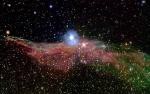 NGC 6960: The Witch's Broom Nebula
23.08.2000
Ten thousand years ago, before the dawn of recorded human history, a new light must suddenly have appeared in the night sky and faded after a few weeks. Today we know this light was an exploding star and record the colorful expanding cloud as the Veil Nebula.
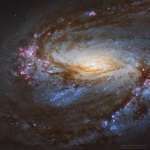 Messier 66 Close Up
27.01.2021
Big, beautiful spiral galaxy Messier 66 lies a mere 35 million light-years away. The gorgeous island universe is about 100 thousand light-years across, similar in size to the Milky Way. This reprocessed Hubble Space Telescope close-up view spans a region about 30,000 light-years wide around the galactic core.
 APOD: 2025 April 21 Б Galaxy Lenses Galaxy from Webb
20.04.2025
Is this one galaxy or two? Although it looks like one, the answer is two. One path to this happening is when a small galaxy collides with a larger galaxy and ends up in the center. But in the featured image, something more rare is going on.
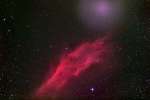 Comet over California
6.03.2008
Still gracing northern skies, a fading Comet Holmes lies at the top edge of this colorful skyview, recorded on March 4. The reddish emission nebula below it is NGC 1499, also known as the California Nebula for its resemblance to the outline of the state on the US west coast.
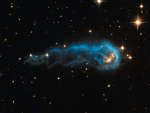 IRAS 20324: Evaporating Protostar
4.09.2013
Will this caterpillar-shaped interstellar cloud one day evolve into a butterfly-shaped nebula? No one is sure. What is sure is that IRAS 20324+4057, on the inside, is contracting to form a new star.
|
January February March April May June July August September October |
|||||||||||||||||||||||||||||||||||||||||||||||||