
|
You entered: Galileo
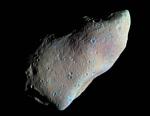 Asteroid Gaspra s Best Face
27.10.2002
Asteroid 951 Gaspra is a huge rock tumbling in space. Gaspra became one of the best-studied spacecraft Galileo flew by. In the above photograph, subtle color variations have been exaggerated to highlight changes in reflectivity, surface structure and composition.
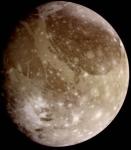 Ganymede: The Largest Moon in the Solar System
20.06.2000
If Ganymede orbited the Sun, it would be considered a planet. The reason is that Jupiter's moon Ganymede is not only the largest moon in the Solar System, it is larger than planets Mercury and Pluto.
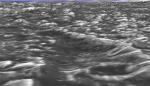 The Hills of Ganymede
23.12.1996
This computer generated 3D close-up view of Jupiter's large moon Ganymede was created using image data from NASA's Galileo spacecraft. Simulating stereo vision by combining two recent images recorded from different angles, 3 dimensional information was reconstructed for a section of Ganymede's surface.
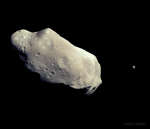 Ida and Dactyl: Asteroid and Moon
17.10.2025
This asteroid has a moon. The robot spacecraft Galileo enroute to explore the Jovian system in 1993, encountered and photographed two asteroids during its long interplanetary voyage. The second minor planet it photographed, 243 Ida, was discovered to have a moon.
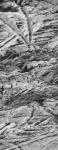 560 Kilometers Above Europa
3.03.1998
This is the closest photograph ever taken of Europa. Last December, NASA's spacecraft Galileo swept past the Jovian moon and took photographs which were released yesterday. Speculation that life-bearing oceans exist beneath Europa's surface caused NASA to put Galileo on orbits that approach Europa.
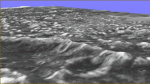 A Flyby View of Ganymede
25.10.1996
This is what it would look like to fly over the surface of Jupiter's moon Ganymede. NASA's robot spacecraft Galileo recently approached only 6000 miles from this frozen ice-ball of a moon. The above image is a digital reconstruction from two images taken during this flyby.
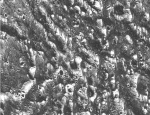 Ancient Cratered Plains on Ganymede
12.07.1996
The largest moon in the Solar System shows regions that are ancient and battered. The high density of craters demonstrate that patches of Ganymede are indeed billions of years old. This photo is one of a series released by NASA two days ago from the Galileo spacecraft orbiting Jupiter.
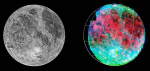 Fields of Minerals on Ganymede
7.11.1996
What treasures lie on the surface of Ganymede? Last week, NASA released a map of Jupiter's largest moon made by the Galileo Orbiter highlighting ice and minerals deposits. The leftmost photograph by Voyager...
 A Continuous Eruption on Jupiters Moon Io
6.06.2000
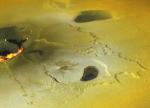
A volcano on Jupiter's moon Io has been photographed recently during an ongoing eruption. Hot glowing lava is visible on the left on this representative-color image. A glowing landscape of plateaus and valleys covered in sulfur and silicate rock surrounds the active volcano.
 Lava Fountain on Jupiter's Io
20.12.1999
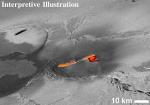
A lava fountain shooting over a kilometer high has been discovered on Jupiter's moon Io. The robot Galileo spacecraft orbiting Jupiter photographed the volcanic eruption during its close flyby of the moon late last month. The fountain is visible in the above mosaic of images from the flyby.
|
January February March April May June July August September October |
|||||||||||||||||||||||||||||||||||||||||||||||||