
|
You entered: Galileo
 Asteroid Gaspra's Best Face
20.10.1995
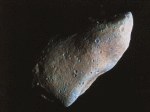
Above is the best yet color image of the asteroid Gaspra based on data returned by NASA's Galileo spacecraft. Color variations have been added to high resolution images and enhanced to highlight changes in reflectivity, surface structure and composition. The illuminated portion of the asteroid is about 11 miles long.
 Europa: Ice Line
18.12.2004
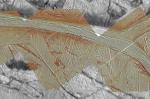
This bright white swath cutting across the surface of icy Jovian moon Europa is known as Agenor Linea. In all about 1000 kilometers long and 5 kilometers wide, only a section is pictured here as part of a combined color and black and white image based on data from the Galileo spacecraft.
 Ganymede: A Really Groovy Moon
11.07.1996
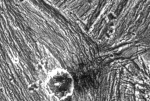
Ganymede's surface is a wrinkled mess. As large ice-sheets shift on the moon's surface, parts of the surface buckle causing high ridges, deep furrows, and parallel grooves. This photo, taken by the Galileo spacecraft currently orbiting Jupiter, was released yesterday. The large circular feature near the picture bottom is a large impact crater.
 Venus: Just Passing By
29.09.2002
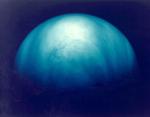
Venus, the second closest planet to the Sun, is a popular way-point for spacecraft headed for the gas giant planets in the outer reaches of the solar system. Why visit Venus first? Using...
 Looking Into an Io Volcano
27.03.2002
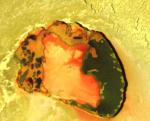
What would it look like to peer into one of the volcanoes currently active on Jupiter's moon Io? The caldera of Tupan Patera, named after a Brazilian thunder god, reveals itself...
 Io: The Fissure King?
29.11.1996
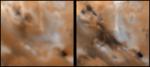
Is Io the solar system's Fissure King? Well, probably not ... but it is the most active volcanic moon. Active volcanoes on Jupiter's moon Io were a surprise discovery of the Voyager missions of the late 1970s.
 Asteroid Gaspra's Best Face
12.07.1998
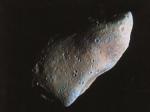
Asteroid 951 Gaspra is a huge rock tumbling in space. Gaspra became one of the best-studied asteroids in 1991 when the spacecraft Galileo flew by. In the above photograph, subtle color variations have been exaggerated to highlight changes in reflectivity, surface structure and composition.
 Up Close to Jupiter's Moon Io
7.06.2000
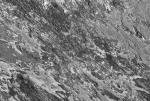
Above is the highest resolution photograph yet taken of the Solar System's strangest moon. The surface of Jupiter's moon Io is home to violent volcanoes that are so active they turn the entire moon inside out. The above photograph shows a region four kilometers across and resolves features only five meters across.
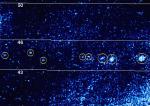 Lightning on Jupiter
12.05.1997
Does lightning occur only on Earth? Spacecraft in our Solar System have detected radio signals consistent with lightning on other planets, including Venus, Jupiter, Saturn, Uranus, and Neptune. In the above photograph, optical flashes from Jupiter were photographed recently by the Galileo orbiter. Each of the circled dots indicates lightning.
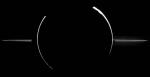 Jupiters Rings Revealed
16.09.1998
Why does Jupiter have rings? Jupiter's rings were discovered in 1979 by the passing Voyager 1 spacecraft, but their origin has always been a mystery. Recent data from the Galileo spacecraft currently orbiting Jupiter now confirms that these rings were created by meteoroid impacts on small nearby moons.
|
January February March April May June July August September October |
|||||||||||||||||||||||||||||||||||||||||||||||||