
|
You entered: Galileo
 Crater On Ice
14.07.2000
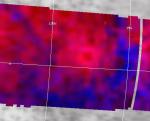
Impact craters are common on Earth's moon but on Jupiter's large ice moon Europa, they are very rare. Over time, both bodies have been subjected to an intense pounding by the solar system's formative debris, but geological activity on Europa's surface seems to have erased most of these impact scars.
 Jupiters Rings Revealed
9.01.2005
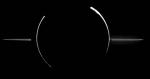
Why does Jupiter have rings? Jupiter's rings were discovered in 1979 by the passing Voyager 1 spacecraft, but their origin was a mystery. Data from the Galileo spacecraft that orbited Jupiter from 1995 to 2003 later confirmed that these rings were created by meteoroid impacts on small nearby moons.
 Jupiters Rings Revealed
16.06.2002
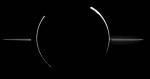
Why does Jupiter have rings? Jupiter's rings were discovered in 1979 by the passing Voyager 1 spacecraft, but their origin was a mystery. Data from the Galileo spacecraft currently orbiting Jupiter later confirmed that these rings were created by meteoroid impacts on small nearby moons.
 Earth and Moon
5.09.2021
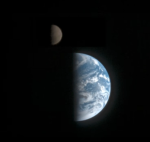
The Earth and Moon are rarely photographed together. One of most spectacular times this occurred was about 30 years ago when the Jupiter-bound Galileo spacecraft zoomed past our home planetary system. Then, robotic Galileo watched from about 15-times the Earth-Moon separation as our only natural satellite glided past our home world.
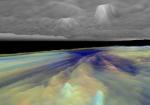 3D View Of Jupiter's Clouds
30.10.1997
Every day is a cloudy day on Jupiter, the Solar System's reigning gas giant. This 3-dimensional visualization presents a simplified model view from between Jovian cloud decks based on imaging and spectral data recorded by the Galileo spacecraft. The separation between the cloud layers and the height variations have been exaggerated.
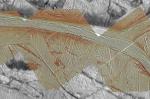 Europa: Ice Line
18.04.2000
This bright white swath cutting across the surface of icy Jovian moon Europa is known as Agenor Linea. In all about 1000 kilometers long and 5 kilometers wide, only a section is pictured here as part of a combined color and black and white image based on data from the Galileo spacecraft.
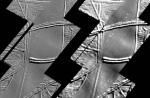 Folding Europa
25.08.2000
Astypalaea Linea on Jovian ice moon Europa is the broad smooth region running through these images recorded by the Galileo spacecraft in 1998. The pictures are different computer processed versions of the same mosaic -- on the left, small scale details have been enhanced while on the right, large scale features are emphasized.
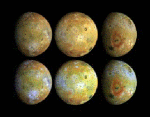 Three Views of Jupiter's Io
3.10.1996
The Galileo spacecraft orbiting Jupiter continues to return impressive results. The Galileo team has just released three more photographs of Jupiter's volcanic moon Io taken in June. These three photos are reflected at the bottom of the above picture, digitally enhanced to better show important features.
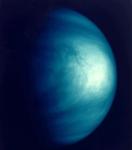 Venus: Just Passing By
1.05.1998
Venus, the second closest planet to the Sun, is a popular way-point for spacecraft headed for the gas giant planets in the outer reaches of the solar system. Why visit Venus first? Using...
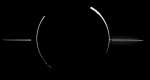 Jupiters Rings Revealed
17.06.2012
Why does Jupiter have rings? Jupiter's rings were discovered in 1979 by the passing Voyager 1 spacecraft, but their origin was a mystery. Data from the Galileo spacecraft that orbited Jupiter from 1995 to 2003 later confirmed that these rings were created by meteoroid impacts on small nearby moons.
|
January February March April May June July August September October |
|||||||||||||||||||||||||||||||||||||||||||||||||