
|
You entered: Galileo
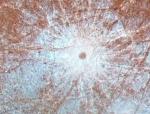 Pwyll: Icy Crater of Europa
13.04.2002
The impact crater Pwyll (a name from Celtic Mythology) is thought to represent one of the youngest features on the surface of Jupiter's moon Europa. A combination of color and high resolution black...
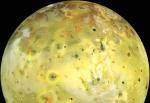 Io in True Color
15.07.2001
The strangest moon in the Solar System is bright yellow. This picture, showing Io's true colors, was taken in 1999 July by the Galileo spacecraft currently orbiting Jupiter. Io's colors derive from sulfur and molten silicate rock. The unusual surface of Io is kept very young by its system of active volcanoes.
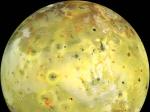 Io in True Color
2.05.2004
The strangest moon in the Solar System is bright yellow. This picture, showing Io's true colors, was taken in 1999 July by the Galileo spacecraft that orbited Jupiter from 1995 to 2003. Io's colors derive from sulfur and molten silicate rock.
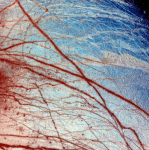 The Cracked Ice Plains of Europa
22.10.1996
What caused the cracks in this giant ice-ball? Jupiter's moon Europa has smoothest surface in the solar system and is composed mostly of cracked water-ice. In the above false-colored picture released last week...
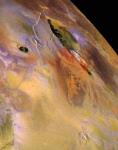 Zal Patera on Jupiter's Moon Io
7.03.2000
The Galileo orbiter's flyby of Io last November captured an unusual part of Jupiter's volcanic moon. From 26,000 kilometers away, Zal Patera was found to be a cauldron of flowing lava, gaseous vents, and tremendous peaks.
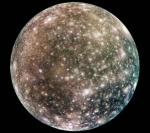 Callisto Full Face
20.01.2002
Callisto's surface shows its age. While probably formed at the same time as Io, the difference between the surfaces of these two moons of Jupiter could hardly be greater. Io's surface is young, shows practically no impact craters, and is continually being repaved by the lava exploding from its many large volcanoes
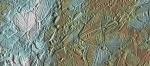 Europa's Disconnected Surface
2.01.1998
Jupiter's moon Europa is so exciting that the Galileo spacecraft orbiting Jupiter has now embarked on an extended mission to study it. Oceans that might exist beneath Europa's surface are thought to be one of the best places to look for life in our Solar System.
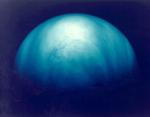 Venus: Just Passing By
25.06.2005
Venus, the second closest planet to the Sun, is by far the brightest of the three planets gathered in this weekend's western sky at sunset. It has also proven to be a popular way-point for spacecraft headed for the gas giant planets in the outer reaches of the solar system. Why visit Venus first?
 Jagged Hills on Jupiters Callisto
28.08.2001
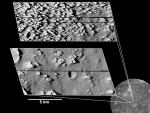
Why does Jupiter's moon Callisto have unusual jagged hills? This mystery came to light after the robot spacecraft Galileo, in orbit around Jupiter since 1995, swooped past the dark moon in May. The resulting pictures were the highest resolution yet obtained for a Jovian moon: objects as small as 3 meters across are discernable.
 Callisto in True Color
11.05.1998
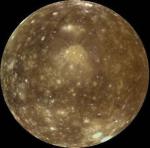
Callisto's surface has many stories to tell. The most distant of Jupiter's Galilean Moons, Callisto shows the highest density of impact craters in the Solar System, but harbors no volcanoes or even any large mountains. Callisto's surface is laced with cracks and craters from
|
January February March April May June July August September October |
|||||||||||||||||||||||||||||||||||||||||||||||||