
|
You entered: Galileo
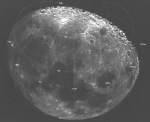 North to the Moon's Pole
22.06.1996
This image is from the voyage of the intrepid Galileo spacecraft as it passed above the Moon's north pole on its long journey to Jupiter. It was made over 60 years after Admiral Byrd became the first to fly over the Earth's north pole.
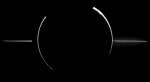 Jupiters Rings Revealed
6.01.2008
Why does Jupiter have rings? Jupiter's rings were discovered in 1979 by the passing Voyager 1 spacecraft, but their origin was a mystery. Data from the Galileo spacecraft that orbited Jupiter from 1995 to 2003 later confirmed that these rings were created by meteoroid impacts on small nearby moons.
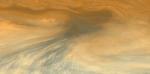 Jupiter's Dry Spots
12.06.1997
Known for its spectacular images of Jupiter's moons, Io, Ganymede, Callisto, and Europa, the robot spacecraft Galileo has also aggressively explored the Jovian atmosphere. In December of 1995, Galileo's atmospheric probe descended into Jupiter's clouds and reported a surprising absence of water.
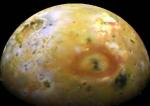 Io's Giant Volcano Pele
5.12.1996
Io has some very large volcanoes. One of the largest is evident near the center of the above photograph and named Pele, for the mythological Polynesian fire goddess. The Galileo spacecraft now orbiting Jupiter took this picture of Jupiter's most active moon in June, although it was released just last week.
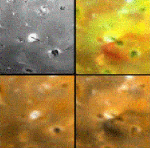 Volcano Euboea Fluctus On Io
8.09.1996
Jupiter's moon Io is turning out to be our Solar System's geologic powerhouse. The churning moon was photographed again just recently on June 27th and again shows signs of violent activity. Shown above are photographs of the volcano Euboea Fluctus taken at different times.
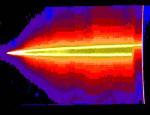 Jupiter's Ring Halo
7.08.1997
Why do small particles hover around Jupiter's rings? These particles form a previously unknown ring halo, recently discovered by the robot spacecraft Galileo currently orbiting Jupiter. Galileo obtained this image when on the far side of Jupiter - from this orientation scattered sunlight makes the halo ring visible.
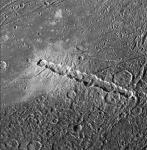 Ganymede: Torn Comet Crater Chain
15.12.2001
This striking line of 13 closely spaced craters on Jupiter's moon Ganymede was photographed by the Galileo spacecraft in 1997. The picture covers an area about 120 miles wide and the chain of craters cuts across a sharp boundary between dark and light terrain. What caused this crater chain?
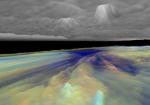 3D View Of Jupiter's Clouds
29.04.2000
Every day is a cloudy day on Jupiter, the Solar System's reigning gas giant. This 3-dimensional visualization presents a simplified model view from between Jovian cloud decks based on imaging and spectral data recorded by the Galileo spacecraft. The separation between the cloud layers and the height variations have been exaggerated.
 Europa: Ancient Water World
5.09.1995
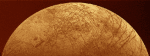
Beneath the cold icy surface of Jupiter's moon Europa are probably the only oceans of water in our Solar System outside of Earth. These oceans, possibly 50 kilometers deep, might also be the most likely local place to find extra-terrestrial life.
 Io Rotating
24.10.2000
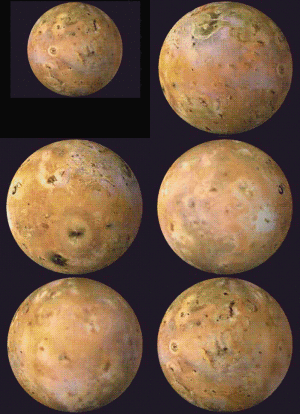
The surface of Io is continually changing. Jupiter's moon is the home to many powerful volcanoes so active they are effectively turning the moon inside out. The above time-lapse sequence is a composite of images taken during two space missions that approached the violent moon: Voyager and Galileo.
|
January February March April May June July August September October |
|||||||||||||||||||||||||||||||||||||||||||||||||