
|
You entered: light
 The Sun Also Rises
24.10.1998
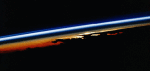
Sunrise seen from low Earth orbit by the shuttle astronauts can be very dramatic indeed ( and the authors apologize to Hemingway for using his title!). In this breathtaking view, the Sun is just visible...
 Why is QSO 1229+204 so Bright?
24.08.1996
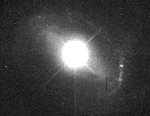
What causes the center of this barred spiral galaxy to light up brighter than almost anything in the universe? The quasar there is a good fraction of the way across our observable universe...
 Dark Sky, Bright Sun
2.09.1997
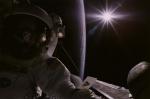
In low Earth orbit there is not enough atmosphere to diffuse and scatter sunlight, so shadows are black and the sky is dark - even when the Sun shines. The harsh lighting produced this dramatic...
 M8: The Lagoon Nebula
7.07.1998
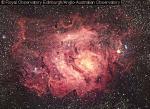
The bright Lagoon Nebula is home to a diverse array of astronomical objects. Particularly interesting sources include a bright open cluster of stars and several energetic star-forming regions. The general red glow is caused by luminous hydrogen gas, while the dark filaments are caused by absorption by dense lanes of dust.
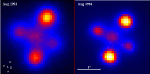 Microlensing of the Einstein Cross
15.12.1996
The famous "Einstein Cross" is a case where a single object is seen four times. Here a very distant QSO happened to be placed right behind a massive galaxy. The gravitational effect...
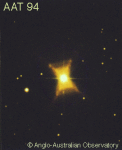 The Red Rectangle
2.11.1995
The unusual geometry of this stellar nebula creates somewhat of a mystery. At the nebula's center is a young binary star system that probably created the nebula, but how? This type of nebula shows a "bipolar flow" which carries a significant amount of mass away from the central stars.
 Wild Duck Open Cluster M11
16.01.1996
Many stars like our Sun were formed in open clusters. The above open cluster, M11, contains thousands of stars and is just over three thousand light years distant. The stars in this cluster all formed together about 150 million years ago. The many bright stars in the cluster appear blue.
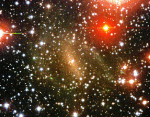 Galaxy Dwingeloo 1 Emerges
1.03.1997
Sometimes you can't see the forest for the trees. But if you look closely at the center of the above photograph, you will see a whole spiral galaxy behind the field of stars.
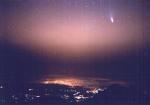 Hale-Bopp Brightest Comet This Century
25.03.1997
A comet as bright as Comet Hale-Bopp is very rare indeed. No comet has emitted or reflected this much light since possibly the Great Comet of 1811. However, since Comet Hale-Bopp is across the inner Solar System from us, it does not appear as bright as Comet West did in 1975.
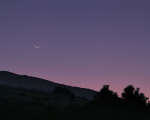 Friday the Moon Smiled
18.11.2017
Friday, an old Moon smiled for early morning risers. Its waning sunlit crescent is captured in this atmospheric scene from clear skies near Bursa, Turkey, planet Earth. In the subtle twilight hues nearby celestial lights are Jupiter (top) and Venus shining close to the eastern horizon.
|
January February March April May June July August September October |
|||||||||||||||||||||||||||||||||||||||||||||||||