
|
You entered: light
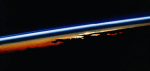 The Sun Also Rises
17.11.1995
Sunrise seen from low Earth orbit by the shuttle astronauts can be very dramatic indeed (and the authors apologize to Hemingway for using his title!). In this breathtaking view, the Sun is just visible...
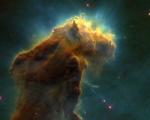 Eagle Eggs in M16
28.02.1998
Star forming regions known as "EGGs" are uncovered at the end of this giant pillar of gas and dust in the Eagle Nebula (M16). EGGs, short for evaporating gaseous globules, are dense regions of mostly molecular hydrogen gas that fragment and gravitationally collapse to form stars.
 Opportunity on Mars
27.01.2004
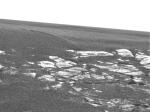
You've just woken up in a small crater on Mars. The surrounding landscape is barren, strange, and alien. You've never been on this world before. You transmit pictures that are instantly rebroadcast all over your home world. You are the eyes for billions of people. You seek adventure.
 Discovery s Dawn
9.04.2010
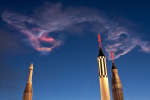
On April 5, visitors to Kennedy Space Center saw these colorful clouds, twisting and drifting through dawn skies. Of course, the clouds were rocket engine plumes from the predawn launch of the space shuttle Discovery on the STS-131 mission to the International Space Station.
 Strawberry Sun
29.08.2013
This striking, otherworldy scene really is a view from planet Earth. The ochre sky and strawberry red sun were photographed on August 22nd near the small village of Strawberry, California, USA. Found along Highway...
 Meteor over the Bay of Naples
17.02.2024
A cosmic dust grain plowing through the upper atmosphere much faster than a falling leaf created this brilliant meteor streak. In a serendipitous moment, the sublime night sky view was captured from the resort island of Capri, in the Bay of Naples, on the evening of February 8.
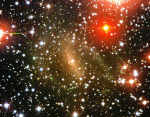 Galaxy Dwingeloo 1 Emerges
2.08.1998
Sometimes you can't see the forest for the trees. But if you look closely at the center of the above photograph, you will see a whole spiral galaxy behind the field of stars.
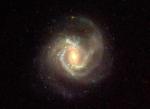 M61: Virgo Spiral Galaxy
22.09.1998
M61 is a barred spiral galaxy located in the nearby Virgo Cluster of Galaxies. Visible in M61 are a host of features common to spiral galaxies: bright spiral arms, a central bar, dust lanes, and bright knots of stars. M61, also known as NGC 4303, in similar to our own Milky Way Galaxy.
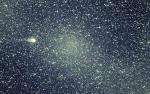 The Gegenschein
25.06.1999
If you look carefully enough, you can even see the glow of the Sun in the opposite direction. At night this glow is known as the gegenschein (German for "counter glow"), and can be seen as a faint glow in an extremely dark sky, as pictured above.
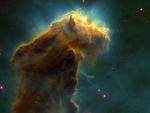 Eagle EGGs in M16
2.04.2000
Star forming regions known as "EGGs" are uncovered at the end of this giant pillar of gas and dust in the Eagle Nebula (M16). EGGs, short for evaporating gaseous globules, are dense regions of mostly molecular hydrogen gas that fragment and gravitationally collapse to form stars.
|
January February March April May June July August September October |
|||||||||||||||||||||||||||||||||||||||||||||||||