
|
You entered: light
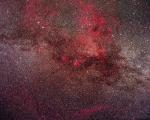 The Gum Nebula Supernova Remnant
20.04.2003
Because the Gum Nebula is the closest supernova remnant, it is actually hard to see. Spanning 40 degrees across the sky, the nebula is so large and faint it is easily lost in the din of a bright and complex background.
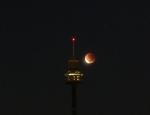 Good Morning Sydney
8.05.2004
Rising before dawn on May 5th, Stephen Thorley looked out across the skyline of Sydney, Australia. And while a leisurely lunar eclipse was clearly in progress, from his vantage point on planet Earth the Moon set as the total phase of the eclipse began.
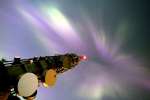 Auroral Corona Over Norway
1.02.2009
Higher than highest communications tower, higher than highest mountain, higher than highest airplane, lies the realm of the aurora. Auroras rarely reach below 60 kilometers, and can range up to 1000 kilometers. Aurora light results from energetic electrons and protons striking molecules in the Earth's atmosphere.
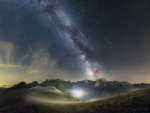 Perseids over the Pyrenees
18.08.2017
This mountain and night skyscape stretches across the French Pyrenees National Park on August 12, near the peak of the annual Perseid meteor shower. The multi-exposure panoramic view was composed from the Col d'Aubisque, a mountain pass, about an hour before the bright gibbous moon rose.
 Night on a Spooky Planet
29.10.2017
What spooky planet is this? Planet Earth of course, on a dark and stormy night in 2013 at Hverir, a geothermally active area along the volcanic landscape in northeastern Iceland. Geomagnetic storms produced...
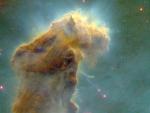 Eagle EGGs in M16
12.08.2001
Star forming regions known as "EGGs" are uncovered at the end of this giant pillar of gas and dust in the Eagle Nebula (M16). EGGs, short for evaporating gaseous globules, are dense regions of mostly molecular hydrogen gas that fragment and gravitationally collapse to form stars.
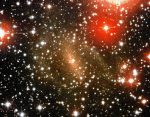 Galaxy Dwingeloo 1 Emerges
17.10.1995
If you look closely at the center of the above photograph, you will see a spiral galaxy behind the field of stars. Named Dwingeloo 1, this nearby galaxy was only discovered recently (1994) because much of its light was obscured by dust, gas and bright stars of our own Milky Way galaxy.
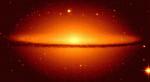 M104: The Sombrero Galaxy
8.02.1997
The famous Sombrero galaxy (M104) is a bright nearby spiral galaxy. The prominent dust lane and halo of stars and globular clusters give this galaxy its name. Something very energetic is going on in the Sombrero's center, as much X-ray light has been detected from it.
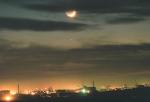 Moon Over Mongolia
16.09.1997
Fighting clouds and the glow of city lights, a young Moon shines over the western horizon of Mongolia's capital Ulaan-Baatar. The thin sunlit crescent is 1.5 days old and strongly over exposed in this image taken on March 10.
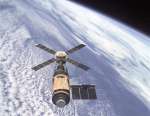 Skylab Over Earth
18.08.2013
Skylab was an orbiting laboratory launched by a Saturn V rocket in May 1973. Skylab, pictured above, was visited three times by NASA astronauts who sometimes stayed as long as two and a half months. Many scientific tests were performed on Skylab, including astronomical observations in ultraviolet and X-ray light.
|
January February March April May June July August September October |
|||||||||||||||||||||||||||||||||||||||||||||||||