
|
You entered: light
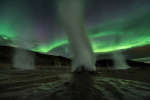 Night on a Spooky Planet
31.10.2013
What spooky planet is this? Planet Earth of course, on the dark and stormy night of September 12 at Hverir, a geothermally active area along the volcanic landscape in northeastern Iceland. Geomagnetic storms produced...
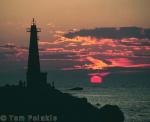 A Seemingly Square Sun
26.05.1998
Isn't the Sun round? Yes, but in the above picture, the Earth's atmosphere makes it appear almost square. Here a layer of air near the Earth was so warm it acted like a giant lens, creating increasingly distorted paths for sunlight to reach the camera.
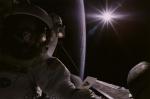 Dark Sky, Bright Sun
14.02.1999
In low Earth orbit there is not enough atmosphere to diffuse and scatter sunlight, so shadows are black and the sky is dark - even when the Sun shines. The harsh lighting produced this dramatic...
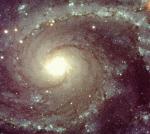 NGC 2997 from VLT
10.03.1999
Add another 8-meter telescope to the list of modern optical telescope giants. Kueyen achieved a first-light photograph of a bright star on March 1, ahead of schedule. The above picture of spiral galaxy...
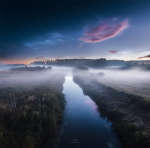 A Northern Summer s Night
7.07.2018
Near a summer's midnight a mist haunts the river bank in this dreamlike skyscape taken on July 3rd from northern Denmark. Reddened light from the Sun a little below the horizon gives an eerie tint to low hanging clouds.
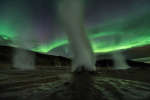 Night on a Spooky Planet
30.10.2022
What spooky planet is this? Planet Earth of course, on a dark and stormy night in 2013 at Hverir, a geothermally active area along the volcanic landscape in northeastern Iceland. Triggered by solar activity, geomagnetic storms produced the auroral display in the starry night sky.
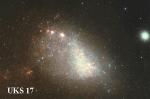 The Small Cloud of Magellan (SMC)
30.04.2000
Almost unknown to casual observers in the northern hemisphere, the southern sky contains two diffuse wonders known as the Magellanic Clouds. The Magellanic Clouds are small irregular galaxies orbiting our own larger Milky Way spiral galaxy.
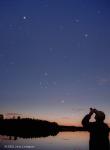 Dusk of the Planets
29.04.2002
A great grouping of planets is now visible to the west just after sunset. Over the next two weeks, Mercury, Venus, Earth, Mars, Jupiter, and Saturn -- all the planets of the inner Solar System -- can be seen in a single knowing glance. The image on the left captured them all in one frame.
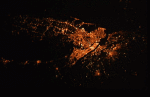 New York at Night
19.11.1995
This tantalizingly clear photo of New York City at night was taken by the astronauts during the Space Radar Laboratory mission of the Space Shuttle Endeavor in March of 1990. In this view, oriented with East up and North to the left, a dense constellation of lights defines the major metropolitan areas.
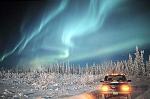 Aurora Over Alaska
4.03.1998
Higher than the highest mountain, higher than the highest airplane, lies the realm of the aurora. Aurora rarely reach below 60 kilometers, and can range up to 1000 kilometers. Aurora light results from solar electrons and protons striking molecules in the Earth's atmosphere.
|
January February March April May June July August September October |
|||||||||||||||||||||||||||||||||||||||||||||||||