
|
You entered: light
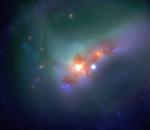 ESO202-G23: Merging Galaxies
1.01.1999
ESO202-G
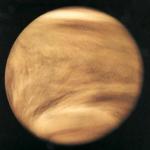 Ultraviolet Venus
7.05.1997
The forecast for Venus is cloudy, cloudy, cloudy. Although similar to the Earth in size and mass, Venus' slightly closer orbit to the Sun create for it a much thicker atmosphere and a much hotter surface. The thick atmosphere was photographed above in ultraviolet light in 1979 by the Pioneer Venus Orbiter.
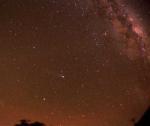 Comet Hyakutake and the Milky Way
17.08.1998
Two years ago, the Great Comet of 1996, Comet Hyakutake, inched across our northern sky during its long orbit around the Sun. Visible above as the bright spot with the faint tail near...
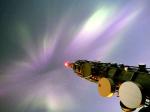 Aurora Over a Communications Tower
28.09.2004
Higher than highest communications tower, higher than highest mountain, higher than highest airplane, lies the realm of the aurora. Auroras rarely reach below 60 kilometers, and can range up to 1000 kilometers. Aurora light results from energetic electrons and protons striking molecules in the Earth's atmosphere.
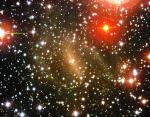 Galaxy Dwingeloo 1 Emerges
9.01.2000
Sometimes you can't see the forest for the trees. But if you look closely at the center of the above photograph, you will see a whole spiral galaxy behind the field of stars.
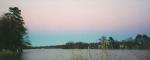 The Belt of Venus
10.11.1999
Although you've surely seen it, you might not have noticed it. During a cloudless twilight, just before sunrise or after sunset, part of the atmosphere above the horizon appears slightly off-color, slightly pink.
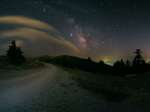 Milky Way Road Trip
5.09.2008
In search of planets and the summer Milky Way, astronomer Tunç Tezel took an evening road trip. Last Saturday, after driving the winding road up Uludag, a mountain near Bursa, Turkey, he was rewarded by this beautiful skyview to the south.
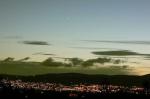 Venus and Jupiter Over Belfast
25.06.2002
Venus and Jupiter appeared to glide right past each other earlier this month. In a slow day-by-day march, Jupiter sank into the sunset horizon while Venus remained high and bright. The conjunction ended the five-planet party visible over the last two months.
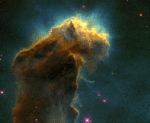 Eagle EGGs in M16
7.11.1995
Star forming regions known as "EGGs" are uncovered at the end of this giant pillar of gas and dust in the Eagle Nebula (M16). EGGs, short for evaporating gaseous globules, are dense regions of mostly molecular hydrogen gas that fragment and gravitationally collapse to form stars.
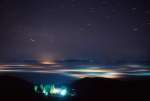 As Above, So Below
3.12.2011
A single, long exposure captured these star trails above a remarkably colorful sea of clouds. As seen from Medvednica mountain, the surrounding peaks and lights illuminating the clouds from below are north of Zagreb, Croatia.
|
January February March April May June July August September October |
|||||||||||||||||||||||||||||||||||||||||||||||||