
|
You entered: light
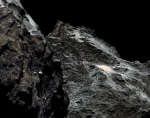 62 Kilometers above Comet Churyumov Gerasimenko
15.09.2014
Spacecraft Rosetta continues to approach, circle, and map Comet Churyumov-Gerasimenko. Crossing the inner Solar System for ten years to reach the vicinity of the comet last month, the robotic spacecraft continues to image the unusual double-lobed comet nucleus. The reconstructed-color image featured, taken about 10 days ago, indicates how dark this comet nucleus is.
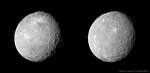 Dark Craters and Bright Spots Revealed on Asteroid Ceres
17.02.2015
What are those bright spots on asteroid Ceres? As the robotic spacecraft Dawn approaches the largest asteroid in the asteroid belt, the puzzle only deepens. Sharper new images taken last week and released yesterday...
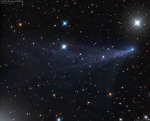 Blue Comet PanSTARRS
12.01.2018
Discovered with the PanSTARRS telescope on September 7, 2016, this Comet PanSTARRS, C/2016 R2, is presently about 24 light minutes (3 AU) from the Sun, sweeping through planet Earth's skies across the background of stars in the constellation Taurus.
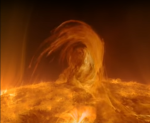 Sun Dance
10.10.2018
Sometimes, the surface of our Sun seems to dance. In the middle of 2012, for example, NASA's Sun-orbiting Solar Dynamic Observatory spacecraft imaged an impressive prominence that seemed to perform a running dive roll like an acrobatic dancer.
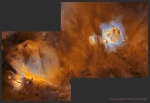 Horsehead and Orion Nebulas
18.03.2019
The dark Horsehead Nebula and the glowing Orion Nebula are contrasting cosmic vistas. Adrift 1,500 light-years away in one of the night sky's most recognizable constellations, they appear in opposite corners of the above stunning two-panel mosaic.
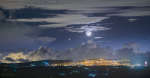 Earthshine Moon over Sicily
18.10.2021
Why can we see the entire face of this Moon? When the Moon is in a crescent phase, only part of it appears directly illuminated by the Sun. The answer is earthshine, also known as earthlight and the da Vinci glow.
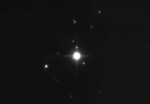 In Motion: Uranus and Moons
30.11.2021
What's that moving across the sky? A planet just a bit too faint to see with the unaided eye: Uranus. The gas giant out past Saturn was tracked earlier this month near opposition -- when it was closest to Earth and at its brightest.
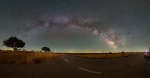 The Road and the Milky Way
11.06.2022
At night you can follow this road as it passes through the Dark Sky Alqueva reserve not too far from Alentejo, Portugal. Or you could stop, look up, and follow the Milky Way through the sky. Both stretch from horizon to horizon in this 180 degree panorama recorded on June 3.
 Late Night Vallentuna
15.08.2024
Bright Mars and even brighter Jupiter are in close conjunction just above the pine trees in this post-midnight skyscape from Vallentuna, Sweden. Taken on August 12 during a geomagnetic storm, the snapshot records the glow of aurora borealis or northern lights, beaming from the left side of the frame.
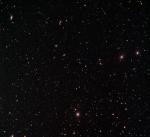 Galaxies Of The Virgo Cluster
26.01.2001
Well over a thousand galaxies are known members of the Virgo Cluster, the closest large cluster of galaxies to our own local group. The galaxy cluster is difficult to see all at once because it covers such a large area on the sky.
|
January February March April May June July August September October |
|||||||||||||||||||||||||||||||||||||||||||||||||