
|
You entered: light
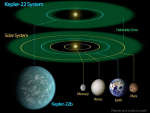 APOD: 2011 December 7 Kepler 22b: An Almost Earth Orbiting an Almost Sun
7.12.2011
Its the closest match to Earth that has yet been found. Recently discovered planet Kepler 22b has therefore instantly become the best place to find life outside our Solar System. The planet's host...
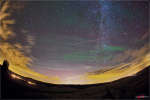 Airglow Over Germany
5.09.2012
Does air glow? It does, but it is usually hard to see. When conditions are right, however, a faint glow about 90 kilometers up can be observed, most easily with a wide-angle long-duration camera exposure.
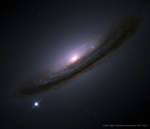 Supernova 1994D and the Unexpected Universe
31.05.2015
Long ago, far away, a star exploded. Supernova 1994D, visible as the bright spot on the lower left, occurred in the outskirts of disk galaxy NGC 4526. Supernova 1994D was not of interest for how different it was, but rather for how similar it was to other supernovae.
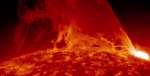 A Solar Prominence Eruption from SDO
6.03.2016
One of the most spectacular solar sights is an erupting prominence. In 2011, NASA's Sun-orbiting Solar Dynamic Observatory spacecraft imaged an impressively large prominence erupting from the surface. The dramatic explosion was captured in ultraviolet light in the above time lapse video covering 90 minutes, where a new frame was taken every 24 seconds.
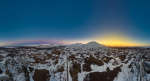 Shadowrise and Sunset
1.06.2017
The road tracking through this stunning 360 degree view crosses a remote mountain area of Jämtland, Sweden, planet Earth. A 3x8 mosaic of still images, the panorama was taken on May 3rd from a small drone 200 meters above the ground.
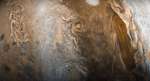 Orbiting Jupiter
7.06.2017
What would it be like to orbit Jupiter? The dramatic featured video depicts just this and was made from images taken by NASA's Juno spacecraft currently orbiting the Jovian giant. Juno recently completed its sixth pass near Jupiter during its looping elliptical six-week orbit.
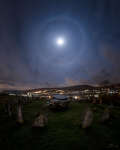 Moon Halo over Stone Circle
2.05.2018
Have you ever seen a halo around the Moon? This fairly common sight occurs when high thin clouds containing millions of tiny ice crystals cover much of the sky. Each ice crystal acts like a miniature lens.
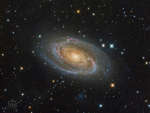 Messier 81
17.04.2019
One of the brightest galaxies in planet Earth's sky is similar in size to our Milky Way Galaxy: big, beautiful Messier 81. Also known as NGC 3031 or Bode's galaxy for its 18th century discoverer, this grand spiral can be found toward the northern constellation of Ursa Major, the Great Bear.
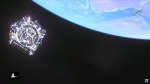 James Webb Space Telescope over Earth
26.12.2021
There's a big new telescope in space. This one, the James Webb Space Telescope (JWST), not only has a mirror over five times larger than Hubble's in area, but can see better in infrared light.
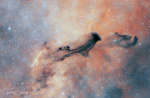 APOD: 2026 February 20 Б B93: A Dark Interstellar Ghost
20.02.2026
"A ghost in the Milky WayББ says Christian Bertincourt, the astrophotographer behind this striking image of Barnard 93 (B93). The 93rd entry in BarnardБs Catalogue of Dark Nebulae, B93 lies within the Small Sagittarius Star Cloud (Messier 24), where its darkness stands in stark contrast to bright stars and gas in the background.
|
January February March April May June July August September October |
|||||||||||||||||||||||||||||||||||||||||||||||||