
|
You entered: light
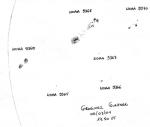 Islands in the Photosphere
25.10.2003
Awash in a sea of plasma and anchored in magnetic fields, sunspots are planet-sized, dark islands in the solar photosphere, the bright surface of the Sun. Before the enlightened(!) age of cameras, solar observers created detailed drawings of sunspots as they changed and progressed across the visible solar disk.
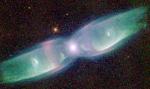 M2 9: Wings of a Butterfly Nebula
1.02.2004
Are stars better appreciated for their art after they die? Actually, stars usually create their most artistic displays as they die. In the case of low-mass stars like our Sun and M2-9 pictured above, the stars transform themselves from normal stars to white dwarfs by casting off their outer gaseous envelopes.
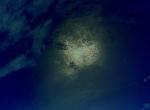 Spiral Eddies On Planet Earth
16.01.1999
Can you identify this wispy stellar nebula? How many light-years from Earth did you say? Resembling a twisting cloud of gas and dust between the stars this swirling form is actually close by - a spiral eddy formed near the North Atlantic Gulf Stream off the East coast of the U. S.
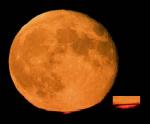 Orange Moon, Red Flash
22.09.2005
This remarkable telescopic image highlights the deep orange cast of a waning gibbous Moon seen very close to the eastern horizon earlier this week, on September 19. In fact, today's equinox...
 Sun Storm: A Coronal Mass Ejection
9.03.2000
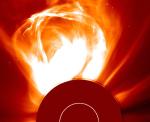
Late last month another erupting filament lifted off the active solar surface and blasted this enormous bubble of magnetic plasma into space. Direct light from the sun is blocked in this picture of the event with the sun's relative position and size indicated by a white half circle at bottom center.
 The 60 inch Reflector
13.12.2008
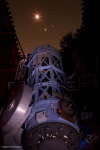
On the night of December 13, 1908, 100 years ago today, the 60-inch diameter reflecting telescope of Mount Wilson Observatory was first tested on the stars. It became the first successful large reflecting telescope.
 Alpine Conjunction
2.01.2009
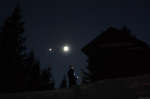
Did you see it? The last conjunction of Moon and bright planets in 2008 featured a young crescent Moon and brilliant Venus in the west after sunset on December 31st. Seen here in dark, clear, mountain air from Mönichkirchen, Austria, are the two celestial beacons that dominate planet Earth's night sky.
 Around the World in 80 Telescopes
3.04.2009
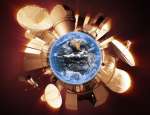
Want to go on an extraordinary voyage? Today you can, by watching Around the World in 80 Telescopes. The 24-hour long webcast is organized by the European Southern Observatory for the International Year of Astronomy cornerstone project 100 Hours of Astronomy.
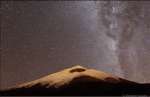 Clouds and Stars over Cotopaxi Volcano in Ecuador
26.05.2010
What's happening above the Cotopaxi volcano in Ecuador? Quite a bit, from the looks of the above one-night, time-lapse movie, taken earlier this month. The majestic volcano is first seen through breaks in fast moving clouds as the movie begins.
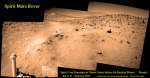 The Last Panorama of the Spirit Rover on Mars
30.05.2011
This is the last thing that the Spirit rover on Mars ever saw. Operating years beyond original expectations, Spirit eventually got mired in martian dirt and then ran out of power when investigating the unusual Home Plate surface feature on Mars.
|
January February March April May June July August September October |
|||||||||||||||||||||||||||||||||||||||||||||||||