
|
You entered: light
 APOD: 2024 October 15 Б Animation: Comet Tsuchinshan ATLAS Tails Prediction
15.10.2024
How bright and strange will the tails of Comet Tsuchinshan-ATLAS become? The comet has brightened dramatically over the few weeks as it passed its closest to the Sun and, just three days ago, passed its closest to the Earth.
 APOD: 2025 April 13 Б An Unusual Hole in Mars
13.04.2025
What created this unusual hole in Mars? Actually, there are numerous holes pictured in this Swiss cheese-like landscape, with all-but-one of them showing a dusty, dark, Martian terrain beneath evaporating, light, carbon dioxide ice.
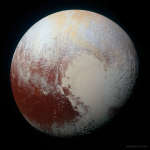 APOD: 2026 September 6 Б Pluto in Enhanced Color
6.09.2026
Pluto is more colorful than we can see. Color data and high-resolution images of our Solar System's most famous dwarf planet, taken by the robotic New Horizons spacecraft during its flyby in 2015 July, have been digitally combined to give an enhanced-color view of this ancient world sporting an unexpectedly young surface.
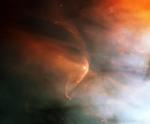 LL Orionis: When Cosmic Winds Collide
13.03.2002
This arcing, graceful structure is actually a bow shock about half a light-year across, created as the wind from young star LL Orionis collides with the Orion Nebula flow. Adrift in Orion's stellar...
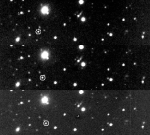 Irregular Moons Discovered Around Uranus
3.11.1997
Where did these two irregular moons of Uranus originate? Last week two previously undiscovered moons of the distant gas planet were confirmed, the first in irregular orbits. All fifteen previously known moons of Uranus are 'regular', circling near the planet's equator. Most of these were discovered by the passing Voyager 2 spacecraft in 1986.
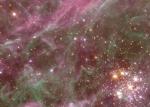 Denizen of the Tarantula Nebula
7.04.1999
The star cluster at lower right, cataloged as Hodge 301, is a denizen of the Tarantula Nebula. An evocative nebula in the southern sky, the sprawling cosmic Tarantula is an energetic star forming region some 168,000 light-years distant in our neighboring galaxy the Large Magellanic Cloud.
 30 Doradus: The Tarantula Zone
12.12.2005
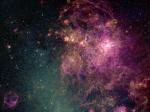
The Tarantula Nebula is more than 1,000 light-years across - a giant emission nebula within our neighboring galaxy the Large Magellanic Cloud. Inside this cosmic arachnid lies a central young cluster of massivestars, cataloged as R136, whose intense radiation and strong winds have helped energize the nebular glow and shape the spidery filaments.
 A Dark Sky over Death Valley
8.05.2007
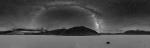
This eerie glow over Death Valley is in danger. Scrolling right will show a spectacular view from one of the darkest places left in the continental USA: Death Valley, California. The above 360-degree full-sky panorama is a composite of 30 images taken two years ago in Racetrack Playa.
 Perseid over Vancouver
16.08.2008
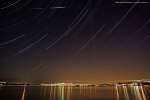
Colorful and bright, the city lights of Vancouver, Canada are reflected in the water in this portrait of the world at night. Recorded on August 12 during the Perseid Meteor Shower, the wide-angle view takes in a large swath along the photographer's eastern horizon.
 A Huge Solar Filament Erupts
15.12.2010
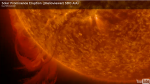
Click the arrow and watch an unusually long filament explode out from the Sun. The filament had been seen hovering over the Sun's surface for over a week before it erupted earlier this month.
|
January February March April May June July August September October |
|||||||||||||||||||||||||||||||||||||||||||||||||