
|
You entered: light
 AR 2192: Giant on the Sun
24.10.2014
As you (safely!) watched the progress of yesterday's partial solar eclipse, you probably also spotted a giant sunspot group. Captured in this sharp telescopic image from October 22nd the complex AR 2192 is beautiful to see, a sprawling solar active region comparable in size to the diameter of Jupiter.
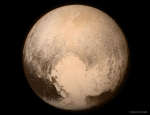 Pluto Resolved
15.07.2015
New Horizons has survived its close encounter with Pluto and has resumed sending back images and data. The robotic spacecraft reported back on time, with all systems working, and with the expected volume of data stored.
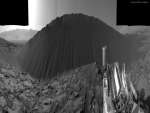 A Dark Sand Dune on Mars
19.01.2016
What is that dark sand dune doing on Mars? NASA's robotic rover Curiosity has been studying it to find out, making this the first-ever up-close investigation of an active sane dune on another world.
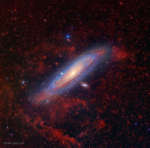 Clouds of Andromeda
8.01.2018
What are those red clouds surrounding the Andromeda galaxy? This galaxy, M31, is often imaged by planet Earth-based astronomers. As the nearest large spiral galaxy, it is a familiar sight with dark dust lanes, bright yellowish core, and spiral arms traced by clouds of bright blue stars.
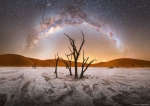 Milky Way over Deadvlei in Namibia
18.04.2018
What planet is this? It is the only planet currently known to have trees. The trees in Deadvlei, though, have been dead for over 500 years. Located in Namib-Naukluft Park in Namibia (Earth), saplings grew after rainfall caused a local river to overflow, but died after sand dunes shifted to section off the river.
 Fermi Science Finals
23.07.2018
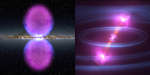
The Fermi Science Playoffs celebrate 10 years of the Fermi Gamma-ray Space Telescope's exploration of the high-energy universe. Surviving all early rounds of voting, these two finalists in the competion square off at last.
 Red Sprite Lightning over Kununurra
25.02.2019
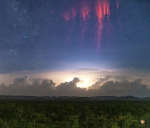
What are those red filaments in the sky? It is a rarely seen form of lightning confirmed only about 30 years ago: red sprites. Recent research has shown that following a powerful positive cloud-to-ground...
 Moon over Andromeda
25.09.2020
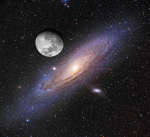
The Great Spiral Galaxy in Andromeda (also known as M31), a mere 2.5 million light-years distant, is the closest large spiral to our own Milky Way. Andromeda is visible to the unaided...
 Venus and the Triply Ultraviolet Sun
6.03.2022
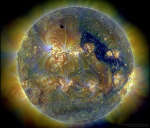
This was a very unusual type of solar eclipse. Typically, it is the Earth's Moon that eclipses the Sun. In 2012, though, the planet Venus took a turn. Like a solar eclipse by the Moon, the phase of Venus became a continually thinner crescent as Venus became increasingly better aligned with the Sun.
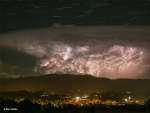 Star Trails and Lightning over the Pyrenees
19.09.2022
The beauty in this image comes in layers. On the bottom layer is the picturesque village of Manlleu in Barcelona, Spain. The six-minute exposure makes car lights into streaks. The next layer is a mountain -- Serra de Bellmunt -- of Europe's famous Pyrenees.
|
January February March April May June July August September October |
|||||||||||||||||||||||||||||||||||||||||||||||||