
|
You entered: light
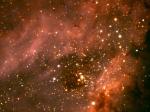 Composing the Omega Nebula
11.12.2000
The Omega Nebula is a massive, complex cloud of dust and gas from which new stars are continually forming. The similarity to the Greek letter capital Omega gives the molecular cloud its popular name, but the nebula is also known as the Swan Nebula, the Horseshoe Nebula, and M17.
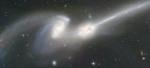 NGC 4676: When Mice Collide
6.05.2002
These two galaxies are pulling each other apart. Known as "The Mice" because they have such long tails, each spiral galaxy has likely already passed through the other and will probably collide again and again until they coalesce.
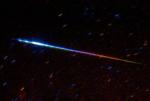 A Perseid Meteor
11.08.2002
The ongoing Perseid Meteor Shower should be at its strongest on August 12 and 13. The best time to watch will be between 2:00 AM and dawn on Monday morning (so plan on setting your alarm tonight!) and then again on Tuesday.
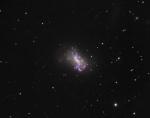 Small Galaxy NGC 4449
3.05.2007
Grand spiral galaxies often seem to get all the glory. Their newly formed, bright, blue star clusters along beautiful, symmetric spiral arms are guaranteed to attract attention. But small irregular galaxies form stars too, like NGC 4449, located about 12 million light-years away.
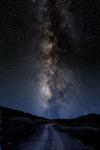 The Milky Road
20.10.2007
Inspired during a visit to Fort Davis, Texas, home of McDonald Observatory and dark night skies, photographer Larry Landolfi created this tantalizing fantasy view. The composited image suggests the Milky Way is a heavenly extension of a deserted country road.
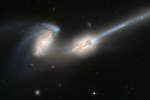 NGC 4676: When Mice Collide
24.02.2008
These two mighty galaxies are pulling each other apart. Known as " The Mice" because they have such long tails, each spiral galaxy has likely already passed through the other. They will probably collide again and again until they coalesce.
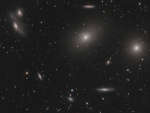 In the Heart of the Virgo Cluster
8.07.2008
The Virgo Cluster of Galaxies is the closest cluster of galaxies to our Milky Way Galaxy. The Virgo Cluster is so close that it spans more than 5 degrees on the sky - about 10 times the angle made by a full Moon.
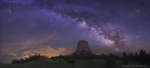 The Milky Way Over Devils Tower
29.07.2009
Was Devil's Tower once an explosive volcano? Famous for its appearance in films such as Close Encounters, the origin of Devil's Tower in Wyoming, USA is still debated, with a leading hypothesis holding that it is a hardened lava plume that probably never reached the surface to become a volcano.
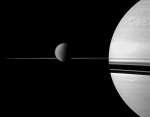 Titan, Rings, and Saturn from Cassini
8.03.2011
How thin are the rings of Saturn? Saturn's rings to be about one kilometer thick, making them many times thinner, in relative proportion, than a razor blade. This thinness sometimes appears in dramatic fashion during an image taken nearly along the ring plane.
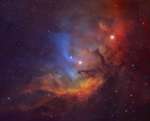 The Tulip in the Swan
26.07.2012
Framing a bright emission region this telescopic view looks out along the plane of our Milky Way Galaxy toward the nebula rich constellation Cygnus the Swan. Popularly called the Tulip Nebula the glowing cloud of interstellar gas and dust is also found in the 1959 catalog by astronomer Stewart Sharpless as Sh2-101.
|
January February March April May June July August September October |
|||||||||||||||||||||||||||||||||||||||||||||||||