
|
You entered: light
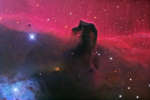 The Horsehead Nebula in Orion
26.11.2008
One of the most identifiable nebulae in the sky, the Horsehead Nebula in Orion, is part of a large, dark, molecular cloud. Also known as Barnard 33, the unusual shape was first discovered on a photographic plate in the late 1800s.
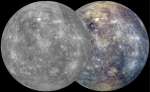 MESSENGER s First Day
8.10.2011
One solar day on a planet is the length of time from noon to noon. A solar day lasts 24 hours on planet Earth. On Mercury a solar day is about 176 Earth days long.
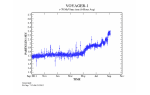 Cosmic Rays at Voyager 1
8.09.2012
Launched on a grand tour of the outer planets in 1977, by good fortune the twin Voyager spacecraft were also headed in the general direction of the Sun's motion relative to nearby stars. Thirty five years later, Voyager 1 appears to be nearing the boundary of the Sun's heliosphere and interstellar space.
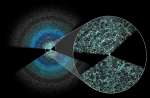 APOD: 2026 April 23 Б Large Scale Structure of the Universe
23.04.2026
This is a map of the universe. The Dark Energy Spectroscopic Instrument (DESI) at Kitt Peak National Observatory, Arizona, has finished its five-year survey. It observed more than 47 million galaxies and quasars and created a 3D map centered on the Earth.
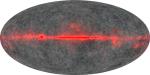 Universe Age from the Microwave Background
17.02.2003
The above sky map tells us the universe is 13.7 billion years old -- but how? At first look, one only sees the microwave glow of gas from our Milky Way Galaxy, coded red, and a spotty pattern of microwaves emitted from the early universe, coded in gray.
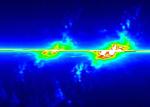 Streaming From A Black Hole
13.06.1997
Glowing gas clouds are streaming from the core of galaxy NGC4151 at hundreds of thousands of miles per hour. A powerful tool, the Hubble Space Telescope's new STIS instrument, makes it possible to map out the cloud velocities - producing this false color "velocity map" for the central regions of NGC4151.
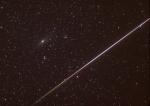 Island Universe, Cosmic Sand
2.08.2003
On August 13, 2002, while counting Perseid meteors under dark, early morning Arizona skies, Rick Scott set out to photograph their fleeting but fiery trails. The equipment he used included a telephoto lens and fast color film. After 21 pictures he'd caught only two meteors, but luckily this was one of them.
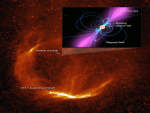 A Dark Pulsar in CTA 1
21.10.2008
Where's the pulsar? Previously, the nebula CTA 1 showed an expanding supernova remnant, a jet, and a point source expected to be a pulsar -- a rotating neutron star producing pulses at radio energies. But no radio pulses were detected.
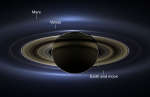 In the Shadow of Saturn
13.11.2013
In the shadow of Saturn, unexpected wonders appear. The robotic Cassini spacecraft now orbiting Saturn drifted in giant planet's shadow earlier this year and looked back toward the eclipsed Sun. Cassini saw a unique and celebrated view.
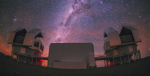 An Active Night over the Magellan Telescopes
21.02.2017
The night sky is always changing. Featured here are changes that occurred over a six hour period in late 2014 June behind the dual 6.5-meter Magellan Telescopes at Las Campanas Observatory in Chile.
|
January February March April May June July August September October |
|||||||||||||||||||||||||||||||||||||||||||||||||