
|
You entered: light
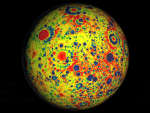 GRAIL Maps the Moons Gravity
19.03.2013
How did the Moon form? To help find out, NASA launched the twin Gravity Recovery and Interior Laboratory (GRAIL) satellites in 2011 to orbit and map the Moon's surface gravity in unprecedented detail.
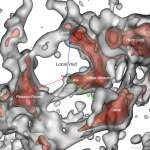 The Local Void in the Nearby Universe
6.08.2019
What does our region of the Universe look like? Since galaxies are so spread out over the sky, and since our Milky Way Galaxy blocks part of the distant sky, it has been hard to tell.
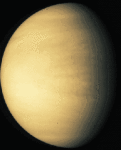 Venus: Earth's Cloudy Twin
23.09.1996
If Venus weren't so cloudy it would be more similar to Earth. This picture by the Galileo spacecraft shows just how cloudy Venus is. Venus is very similar to Earth in size and mass - and so is sometimes referred to as Earth's sister planet - but Venus has a quite different climate.
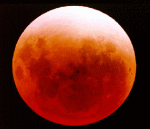 A Lucky Lunar Eclipse
3.04.1996
Tonight's full moon would normally washout the spectacle of Comet Hyakutake's lovely tail, even for those far from light polluted skies. Except that tonight comet observers are in luck - the dance of the planets calls for a total lunar eclipse! Lunar eclipses are caused when the Moon passes through the Earth's shadow.
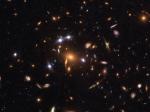 A Five Quasar Gravitational Lens
24.05.2006
What's happening near the center of this cluster of galaxies? At first glance, it appears that several strangely elongated galaxies and fully five bright quasars exist there. In reality, an entire cluster of galaxies is acting as a gigantic gravitational lens that distorts and multiply-images bright objects that occur far in the distance.
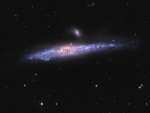 The Whale Galaxy
2.05.2009
NGC 4631 is a big beautiful spiral galaxy. Seen edge-on, it lies only 25 million light-years away in the well-trained northern constellation Canes Venatici. The galaxy's slightly distorted wedge shape suggests to some a cosmic herring and to others its popular moniker, The Whale Galaxy.
 Airglow, Gegenschein, and Milky Way
20.04.2013
As far as the eye could see, it was a dark night at Las Campanas Observatory in the southern Atacama desert of Chile. But near local midnight on April 11, this mosaic of 3 minute long exposures revealed a green, unusually intense, atmospheric airglow stretching over thin clouds.
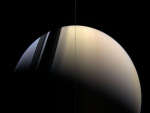 Saturn in Blue and Gold
13.04.2014
Why is Saturn partly blue? The above picture of Saturn approximates what a human would see if hovering close to the giant ringed world. The above picture was taken in 2006 March by the robot Cassini spacecraft now orbiting Saturn. Here Saturn's majestic rings appear directly only as a thin vertical line.
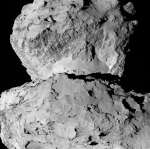 Contrasting Terrains on Comet Churyumov Gerasimenko
19.08.2014
Where should Philae land? As ESA's robotic spacecraft Rosetta circles toward Comet 67P/ Churyumov-Gerasimenko, a decision must eventually be made as to where its mechanical lander should attempt to touch-down. Reaching the comet...
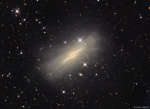 The Edge On Spindle Galaxy
25.07.2018
What kind of celestial object is this? A relatively normal galaxy -- but seen from its edge. Many disk galaxies are actually just as thin as NGC 5866, pictured here, but are not seen edge-on from our vantage point. A perhaps more familiar galaxy seen edge-on is our own Milky Way Galaxy.
|
January February March April May June July August September October |
|||||||||||||||||||||||||||||||||||||||||||||||||