
|
You entered: light
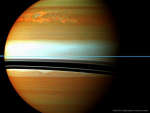 A Long Storm System on Saturn
15.09.2019
It was one of the largest and longest lived storms ever recorded in our Solar System. First seen in late 2010, the above cloud formation in the northern hemisphere of Saturn started larger than the Earth and soon spread completely around the planet.
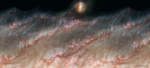 Unwinding M51
21.08.2020
The arms of a grand design spiral galaxy 60,000 light-years across are unwound in this digital transformation of the magnificent 2005 Hubble Space Telescope portrait of M51. In fact...
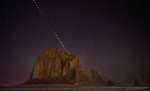 APOD: 2026 March 5 Б Total Lunar Eclipse over Tse Bitai
5.03.2026
Earlier this week, EarthБs shadow swept across the full Moon in the yearБs only total lunar eclipse. This stunning sequence combines images showing the MoonБs path across the night sky. Each lunar image captures our planetБs shadow gradually engulfing the Moon, culminating in its red glow.
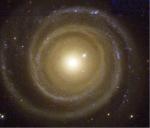 The Spiral Arms of NGC 4622
25.01.2002
While stirring a morning cup of coffee and thinking cosmic thoughts many astronomers would glance at this Hubble Space Telescope image of spiral galaxy NGC 4622 and assume that the galaxy was rotating counterclockwise in the picture.
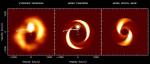 IP Pegasi: Spiral Star
22.08.1997
Spiral arms aren't just for galaxies. A hot disk of gas surrounding a compact white dwarf star in the constellation of Pegasus has recently been revealed to be imprinted with this dramatic pattern.
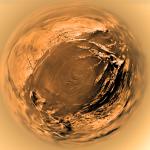 Descent Panorama of Saturns Titan
8.05.2006
You're the first spacecraft ever to descend to Titan -- what do you see? Immediately after the Huygen's probe pierced the cloud deck of Saturn's moon Titan last January, it took a unique series of pictures of one of the Solar System's most mysterious moon's.
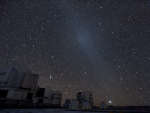 The Gegenschein Over Chile
7.05.2008
Is the night sky darkest in the direction opposite the Sun? No. In fact, a rarely discernable faint glow known as the gegenschein (German for "counter glow") can be seen 180 degrees around from the Sun in an extremely dark sky. The gegenschein is sunlight back-scattered off small interplanetary dust particles.
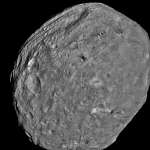 Asteroid Vesta Full Frame
2.08.2011
Why is the northern half of asteroid Vesta more heavily cratered than the south? No one is yet sure. This unexpected mystery has come to light only in the past few weeks since the robotic Dawn mission became the first spacecraft to orbit the second largest object in the asteroid belt between Mars and Jupiter.
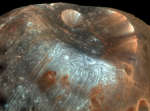 Stickney Crater
18.01.2013
Stickney Crater, the largest crater on the martian moon Phobos, is named for Chloe Angeline Stickney Hall, mathematician and wife of astronomer Asaph Hall. Asaph Hall discovered both the Red Planet's moons in 1877.
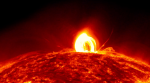 Coronal Rain on the Sun
26.02.2013
Does it rain on the Sun? Yes, although what falls is not water but extremely hot plasma. An example occurred in mid-July 2012 after an eruption on the Sun that produced both a Coronal Mass Ejection and a moderate solar flare. What was more unusual, however, was what happened next.
|
January February March April May June July August September October |
|||||||||||||||||||||||||||||||||||||||||||||||||