
|
You entered: light
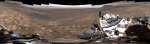 Mars Panorama from Curiosity
6.03.2020
The Mars Rover named Curiosity recorded high-resolution, 360 degree views of its location on Mars late last year. The panoramic scene was stitched from over 1,000 images from Curiosity's Mast camera or Mastcam.
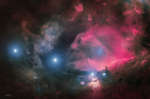 Orions Belt Region in Gas and Dust
11.01.2022
You may have seen Orion's belt before -- but not like this. The three bright stars across this image are, from left to right, Mintaka, Alnilam, and Alnitak: the iconic belt stars of Orion.
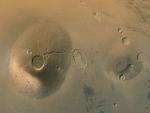 Ancient Volcanos of Mars
8.08.2002
Findings of ancient martian microbial fossils in meteorites and liquid water related features on Mars' surface are currently controversial issues. But one thing long established by space-based observations of the Red Planet is the presence of volcanos, as Mars supports some of the largest volcanos in the solar system.
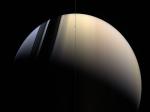 Saturn in Blue and Gold
3.05.2006
Why is Saturn partly blue? The above picture of Saturn approximates what a human would see if hovering close to the giant ringed world. The above picture was taken in mid-March by the robot Cassini spacecraft now orbiting Saturn. Here Saturn's majestic rings appear directly only as a thin vertical line.
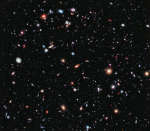 The Hubble Extreme Deep Field
14.10.2012
What did the first galaxies look like? To help answer this question, the Hubble Space Telescope has just finished taking the eXtreme Deep Field (XDF), the deepest image of the universe ever taken in visible light.
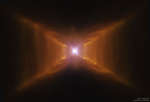 The Red Rectangle Nebula from Hubble
9.05.2018
How was the unusual Red Rectangle nebula created? At the nebula's center is an aging binary star system that surely powers the nebula but does not, as yet, explain its colors. The unusual...
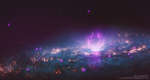 X Ray Superbubbles in Galaxy NGC 3079
5.03.2019
What created these huge galactic superbubbles? Two of these unusual bubbles, each spanning thousands of light-years, were recently discovered near the center of spiral galaxy NGC 3079. The superbubbles, shown in purple on the image right, are so hot they emit X-rays detected by NASA's Earth-orbiting Chandra X-Ray Observatory.
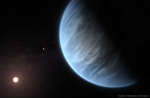 Water Vapor Discovered on Distant Exoplanet
17.09.2019
Where else might life exist? One of humanity's great outstanding questions, locating planets where extrasolar life might survive took a step forward recently with the discovery of a significant amount of water vapor in the atmosphere of distant exoplanet K2-18b.
 APOD: 2024 May 8 Б Visualization: A Black Hole Accretion Disk
8.05.2024
What would it look like to circle a black hole? If the black hole was surrounded by a swirling disk of glowing and accreting gas, then the great gravity of the black hole would deflect light emitted by the disk to make it look very unusual. The featured animated video gives a visualization.
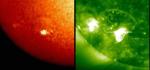 Solar Shock Wave
30.04.1999
On September 24, 1997 a shock wave blasted across the surface of the sun at speeds of 250 to 600 kilometers per second. On planet Earth, observer Barry Reynolds photographed the expanding shock front (left) in the light emitted by hydrogen atoms at the solar surface.
|
January February March April May June July August September October |
|||||||||||||||||||||||||||||||||||||||||||||||||