
|
You entered: light
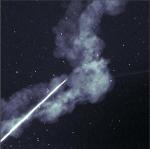 Leonid Glowworm
28.04.2000
Recent Leonid meteor showers have been rich in bright fireball meteors which leave lingering trails stretching across the night sky. These trails, or persistent trains, are mysteriously self-luminescent and do not shine by reflected light.
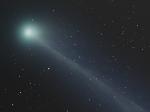 The Ghostly Tail of Comet SWAN
6.11.2006
What causes the structure in Comet SWAN's tail? Comet SWAN, which unexpectedly flared up to naked-eye brightness last week, has been showing detail in its ion tail that might be described as ghostly.
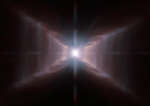 The Red Rectangle Nebula from Hubble
14.06.2010
How was the unusual Red Rectangle nebula created? At the nebula's center is a young binary star system that surely powers the nebula but does not, as yet, explain its colors. The unusual...
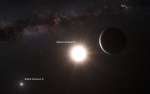 A View from Next Door
18.10.2012
Located just next door, Alpha Centauri is the closest star system to the Sun. A view from our interstellar neighbor a mere 4.3 light-years away is shown in this illustration. The Sun is at the upper right, a bright star against the background of the Milky Way.
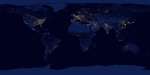 Earth at Night
7.12.2012
This remarkably complete view of Earth at night is a composite of cloud-free, nighttime images. The images were collected during April and October 2012 by the Suomi-NPP satellite from polar orbit about 824 kilometers (512 miles) above the surface using its Visible Infrared Imaging Radiometer Suite (VIIRS).
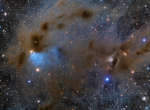 Young Stars and Dusty Nebulae in Taurus
30.03.2017
This complex of dusty nebulae lingers along the edge of the Taurus molecular cloud, a mere 450 light-years distant. Stars are forming on the cosmic scene. Composed from almost 40 hours of image data...
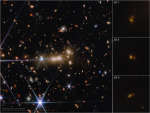 APOD: 2023 January 18 Б MACS0647: Gravitational Lensing of the Early Universe by Webb
18.01.2023
Gravitational lensing by the galaxy cluster MACS0647 -- in which the massive foreground cluster distorts and lenses the light emitted by distant background galaxies along the line of sight Б is on vivid display here in this recent multi-color infrared image from the James Webb Space Telescope (JWST).
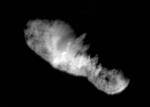 Comet Borrelly's Nucleus
26.09.2001
What does a comet nucleus look like? To answer this question, NASA controllers drove an aging probe through the hostile environs of a distant comet, expecting that even if comet fragments disabled the spacecraft, it would be worth the risk. The probe, Deep Space 1, survived.
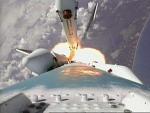 Launch of the Spirit Rover Toward Mars
28.07.2003
Next stop: Mars. Last month the first of two missions to Mars was launched from Cape Canaveral, Florida, USA above a Boeing Delta II rocket. Pictured above, solid fuel boosters are seen falling away as light from residual exhaust is reflected by the soaring rocket.
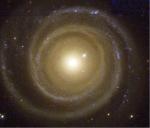 The Spiral Arms of NGC 4622
21.02.2004
While stirring a morning cup of coffee and thinking cosmic thoughts many astronomers would glance at this Hubble Space Telescope image of spiral galaxy NGC 4622 and assume that the galaxy was rotating counterclockwise in the picture.
|
January February March April May June July August September October |
|||||||||||||||||||||||||||||||||||||||||||||||||