
|
You entered: spacecraft
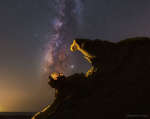 Jupiter Engulfed and the Milky Way
7.08.2019
This is a good month to see Jupiter. To find our Solar System's largest planet in your sky, look toward the southeast just after sunset -- Jupiter should be the brightest object in that part of the sky.
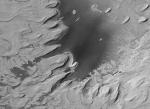 Ancient Layered Rocks on Mars
27.11.2001
Is this a picture of Mars or Earth? Oddly enough, it is a picture of Mars. What may appear to some as a terrestrial coastline is in fact a formation of ancient layered rocks and wind-blown sand on Mars. The above-pictured region spans about three kilometers in Schiaparelli Crater.
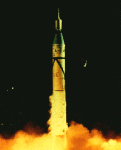 The First Explorer
18.05.1997
The first US spacecraft was Explorer 1. The cylindrical 30 pound satellite was launched (above) as the fourth stage of a Jupiter-C rocket (a modified US Army Redstone ballistic missile) and achieved orbit on January 31, 1958.
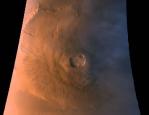 Haunting Mars
31.10.1997
This Halloween, the news about Mars is good news - Mars Global Surveyor will resume aerobraking into a mapping orbit around the haunting red planet. Wide angle cameras onboard the spacecraft recently recorded this shadowy image of Olympus Mons, the Solar System's largest volcano, from an altitude of over 100 miles.
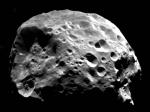 Phoebe: Comet Moon of Saturn
30.06.2004
Was Saturn's moon Phoebe once a comet? Images from the robotic Cassini spacecraft taken two weeks ago when entering the neighborhood of Saturn indicate that Phoebe may have originated in the outer Solar System.
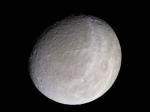 Saturns Moon Rhea from Cassini
15.02.2005
Each moon of Saturn seems to come with its own mystery. Rhea, Saturn's second largest moon behind Titan, shows unusual wisps, visible above as light colored streaks. Higher resolution images of the wisps show them to be made of long braided fractures.
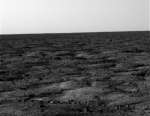 A New Horizon for Phoenix
26.05.2008
This flat horizon stretches across the red planet as seen by the Phoenix spacecraft after yesterday's landing on Mars. Touching down shortly after 7:30pm Eastern Time, Phoenix made the first successful soft landing on Mars, using rockets to control its final speed, since the Viking landers in 1976.
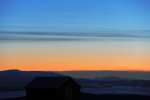 Mercury and Jupiter at Sunset
18.03.2011
When warm sunset hues begin to fade, two celestial beacons now shine in the evening twilight, Mercury and Jupiter. Wandering away from the Sun in planet Earth's sky, Mercury will offer good views this month as spring approaches in the northern hemisphere where the ecliptic plane makes a steep angle with the western horizon.
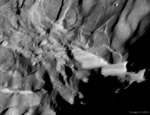 Verona Rupes: Tallest Known Cliff in the Solar System
27.11.2016
Could you survive a jump off the tallest cliff in the Solar System? Quite possibly. Verona Rupes on Uranus' moon Miranda is estimated to be 20 kilometers deep -- ten times the depth of the Earth's Grand Canyon.
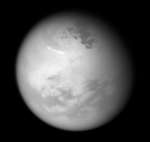 Northern Summer on Titan
20.06.2020
Today's solstice brings summer to planet Earth's northern hemisphere. But the northern summer solstice arrived for ringed planet Saturn over three years ago on May 24, 2017. Orbiting the gas giant, Saturn's moon Titan experiences the Saturnian seasons.
|
January February March April May June July August September October |
|||||||||||||||||||||||||||||||||||||||||||||||||