
|
You entered: spacecraft
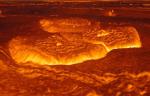 Venus Once Molten Surface
16.09.2001
If you could look at Venus with radar eyes - this is what you might see. This computer reconstruction of the surface of Venus was created from data from the Magellan spacecraft. Magellan orbited Venus and used radar to map our neighboring planet's surface between 1990 and 1994.
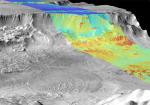 Night and Day in Melas Chasma on Mars
16.12.2002
What types of terrain are found on Mars? Part of the answer comes from thermal imaging by the robot spacecraft 2001 Mars Odyssey currently orbiting Mars. The above picture is a superposition of two infrared images, a black and white image taken during Martian daylight and a false-color image taken at night.
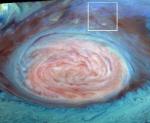 Storm Clouds Over Jupiter
27.11.1996
Storm clouds, similar to the familiar cumulonimbus thunderheads of Earth, appear to be present on Jupiter. The mosaic of images above shows the region near the raging edge of Jupiter's Great Red Spot, itself some 2 to 3 Earths wide, as observed by the Galileo spacecraft in June of this year.
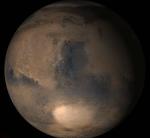 Northern Spring on Mars
25.03.2006
Astronomical spring came to planet Earth's northern hemisphere this week (and autumn to the south) with the equinox on March 20th. But on Mars, northern spring began on January 22nd. Still in northern...
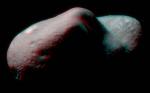 Stereo Eros
24.02.2000
Get out your red/blue glasses and float next to asteroid 433 Eros, 260 million kilometers away! Orbiting the Sun once every 1.8 earth-years, asteroid Eros is a diminutive 40 x 14 x 14 kilometer world of undulating horizons, craters, boulders and valleys.
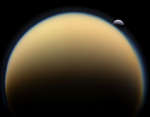 Tethys Behind Titan
27.01.2010
What's that behind Titan? It's another of Saturn's moons: Tethys. The robotic Cassini spacecraft orbiting Saturn captured the heavily cratered Tethys slipping behind Saturn's atmosphere-shrouded Titan late last year. The largest crater on Tethys, Odysseus, is easily visible on the distant moon.
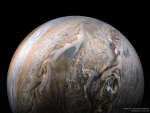 Tumultuous Clouds of Jupiter
6.01.2020
Some cloud patterns on Jupiter are quite complex. The featured tumultuous clouds were captured in May by NASA's robotic Juno spacecraft currently orbiting our Solar System's largest planet. The image was taken...
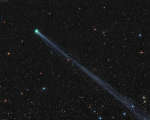 Long Tailed Comet SWAN
8.05.2020
Blowing in the solar wind the spectacular ion tail of Comet SWAN (C/2020 F8) extends far across this 10 degree wide telephoto field of view. Captured on May 2 its greenish coma was about 6 light-minutes from Earth. The pretty background starfield lies near the border of the constellations Cetus and Aquarius.
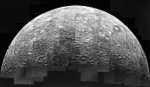 Mercury: A Cratered Inferno
12.09.1996
Mercury's surface looks similar to our Moon's. Each is heavily cratered and made of rock. Mercury's diameter is about 4800 km, while the Moon's is slightly less at about 3500 km (compared with about 12,700 km for the Earth). But Mercury is unique in many ways.
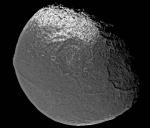 Saturns Iapetus: Moon with a Strange Surface
1.02.2005
What has happened to Saturn's moon Iapetus? A strange ridge crosses the moon near the equator, visible near the bottom of the above image, making Iapetus appear similar to the pit of a peach. Half of Iapetus is so dark that it can nearly disappear when viewed from Earth.
|
January February March April May June July August September October |
|||||||||||||||||||||||||||||||||||||||||||||||||