
|
You entered: spacecraft
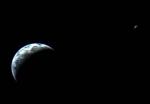 Nozomi: Earth and Moon
4.09.1998
Japan launched its first mission to orbit Mars, Nozomi (Hope), on July 3rd from the Kagoshima Space Center on the island of Kyushu. Nozomi's goal is to explore the Martian atmosphere and magnetic field as well as regions of the planet's surface and moons.
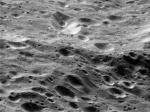 620 Kilometers Above Rhea
13.12.2005
What does the surface of Saturn's moon Rhea look like? To help find out, the robot Cassini spacecraft currently orbiting Saturn was directed to fly right past the second largest moon of the gas giant planet late last month.
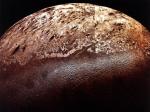 Triton: Neptunes Largest Moon
4.03.2007
In October of 1846, William Lassell was observing the newly discovered planet Neptune. He was attempting to confirm his observation, made just the previous week, that Neptune had a ring. But this time he discovered that Neptune had a satellite as well.
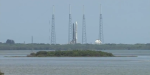 Juno Rockets Toward Jupiter
9.08.2011
Next stop: Jupiter. Last week included one of the few times in history that humanity launched something completely off the Earth, moving away so fast that it will never return. Well, almost -- Juno...
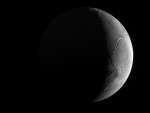 Crescent Enceladus
9.03.2019
Peering from the shadows, the Saturn-facing hemisphere of tantalizing inner moon Enceladus poses in this Cassini spacecraft image. North is up in the dramatic scene captured during November 2016 as Cassini's camera was pointed in a nearly sunward direction about 130,000 kilometers from the moon's bright crescent.
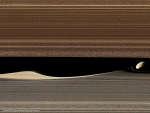 Daphnis and the Rings of Saturn
3.11.2019
What's happening to the rings of Saturn? A little moon making big waves. The moon is 8-kilometer Daphnis and it is making waves in the Keeler Gap of Saturn's rings using just its gravity -- as it bobs up and down, in and out.
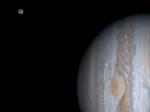 Jupiter, Europa, and Callisto
2.01.2001
As the robot Cassini spacecraft rounds Jupiter on its way toward Saturn, it has taken a sequence of images of the gas giant with its four largest moons. Previously released images have highlighted Ganymede and Io. Pictured above are the two remaining Galilean satellites: Europa and Callisto.
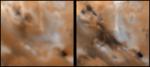 Io: The Fissure King?
29.11.1996
Is Io the solar system's Fissure King? Well, probably not ... but it is the most active volcanic moon. Active volcanoes on Jupiter's moon Io were a surprise discovery of the Voyager missions of the late 1970s.
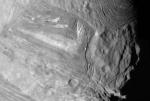 Miranda
19.02.1998
Miranda is a bizarre world which surely had a tempestuous past. The innermost of the larger Uranian moons, Miranda is almost 300 miles in diameter and was discovered only 50 years ago (February 16, 1948) by the renown American planetary astronomer Gerard Kuiper.
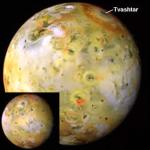 A Newly Active Volcano On Jupiters Io
16.10.2001
Would a volcano plume discovered in January above Jupiter's Moon Io still be active months later? To answer this question, the robot spacecraft Galileo currently in orbit around Jupiter was maneuvered to image the plume site during its recent flyby of Io in August.
|
January February March April May June July August September October |
|||||||||||||||||||||||||||||||||||||||||||||||||