
|
You entered: spacecraft
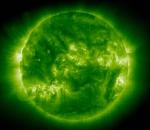 The Iron Sun
25.09.2004
The ultraviolet light emitted by eleven times ionized iron at temperatures over 2 million degrees Farenheit was used to record the above picture of the Sun on September 22, 2001, the date of that year's autumnal equinox.
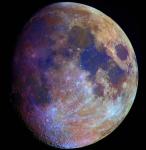 The Color of the Moon
16.02.2006
Earth's Moon is normally seen in subtle shades of grey or yellow. But small color differences have been greatly exaggerated to make this dramatic mosaic image of the Moon's gibbous phase. The familiar Sea of Tranquility (Mare Tranquillitatis) is the blue area right of center.
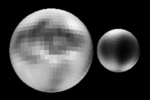 Mysterious Pluto and Charon
9.04.2000
Pluto is the only planet in our Solar System remaining unphotographed by a passing spacecraft. Distant Pluto and its moon Charon therefore remain somewhat mysterious. In addition to direct imaging by the Hubble Space...
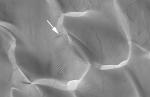 Aeolian Mars
2.02.2000
Mars' atmosphere is relatively thin, still when martian winds blow they weather and shape its surface. Like familiar aeolian features on Earth, this field of dunes within Mars' Rabe crater exhibits graceful undulating ridges which can shift as windblown material is deposited on the dunes' windward face and falls away down the steeper leeward slopes.
 Mountains of Titan
14.12.2006
Peering through the thick, hazy atmosphere of Saturn's largest moon, an infrared camera onboard the Cassini spacecraft recorded this view of the tallest mountains ever seen on Titan. Captured during a flyby...
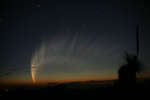 The Magnificent Tail of Comet McNaught
6.12.2009
Comet McNaught, the Great Comet of 2007, was the brightest comet of the last 40 years. Its spectacular tail spread across the sky and was breathtaking to behold from dark locations for many Southern Hemisphere observers.
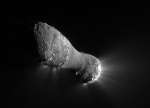 700 Kilometers Below Comet Hartley 2
8.11.2010
What kind of comet is this? Last week, NASA's robotic EPOXI spacecraft whizzed past Comet 103P/Hartley, also known as Comet Hartley 2, and recorded images and data that are both strange and fascinating. EPOXI was near its closest approach -- about 700 kilometers away -- when it snapped the above picture.
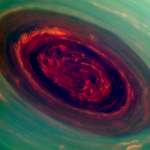 Saturn Hurricane
2.05.2013
Acquiring its first sunlit views of far northern Saturn late last year, the Cassini spacecraft's narrow-angle camera recorded this stunning image of the vortex at the ringed planet's north pole. The false...
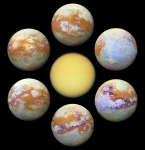 Seeing Titan
18.08.2018
Shrouded in a thick atmosphere, Saturn's largest moon Titan really is hard to see. Small particles suspended in the upper atmosphere cause an almost impenetrable haze, strongly scattering light at visible wavelengths and hiding Titan's surface features from prying eyes.
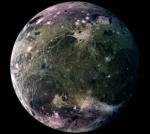 Ganymede Mosaic
4.03.1999
Ganymede, one of the four Galilean moons of Jupiter, is the largest moon in the Solar System. With a diameter of 5,260 kilometers it is even larger than planets Mercury and Pluto and just over three quarters the size of Mars. Ganymede is locked in synchronous rotation with Jupiter.
|
January February March April May June July August September October |
|||||||||||||||||||||||||||||||||||||||||||||||||