
|
You entered: spacecraft
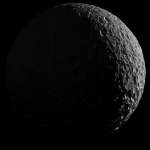 Mimas in Saturnlight
30.07.2021
Peering from the shadows, the Saturn-facing hemisphere of Mimas lies in near darkness alongside a dramatic sunlit crescent. The mosaic was captured near the Cassini spacecraft's final close approach on January 30, 2017. Cassini's camera was pointed in a nearly sunward direction only 45,000 kilometers from Mimas.
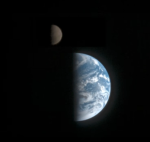 Earth and Moon
5.09.2021
The Earth and Moon are rarely photographed together. One of most spectacular times this occurred was about 30 years ago when the Jupiter-bound Galileo spacecraft zoomed past our home planetary system. Then, robotic Galileo watched from about 15-times the Earth-Moon separation as our only natural satellite glided past our home world.
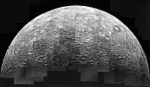 Mercury: A Cratered Inferno
30.11.1997
Mercury's surface looks similar to our Moon's. Each is heavily cratered and made of rock. Mercury's diameter is about 4800 km, while the Moon's is slightly less at about 3500 km (compared with about 12,700 km for the Earth). But Mercury is unique in many ways.
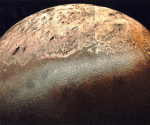 Triton: Neptune's Largest Moon
10.10.1996
Today marks the 150th anniversary of the discovery of Triton. On October 10 1846, William Lassell was observing the newly discovered planet Neptune. He was attempting to confirm his observation, made just the previous week, that Neptune had a ring. But this time he discovered that Neptune had a satellite as well.
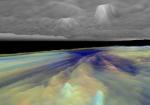 3D View Of Jupiter's Clouds
30.10.1997
Every day is a cloudy day on Jupiter, the Solar System's reigning gas giant. This 3-dimensional visualization presents a simplified model view from between Jovian cloud decks based on imaging and spectral data recorded by the Galileo spacecraft. The separation between the cloud layers and the height variations have been exaggerated.
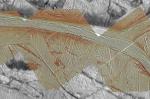 Europa: Ice Line
18.04.2000
This bright white swath cutting across the surface of icy Jovian moon Europa is known as Agenor Linea. In all about 1000 kilometers long and 5 kilometers wide, only a section is pictured here as part of a combined color and black and white image based on data from the Galileo spacecraft.
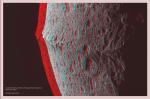 Iapetus: 3D Equatorial Ridge
15.09.2007
This bizarre, equatorial ridge extending across and beyond the dark, leading hemisphere of Iapetus gives the two-toned Saturnian moon a distinct walnut shape. With red/blue glasses you can check out a remarkable stereo composition of this extraordinary feature -- based on close-up images from this week's Cassini spacecraft flyby.
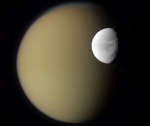 Saturns Moons Dione and Titan from Cassini
20.04.2010
What would it be like to see a sky with many moons? Such is the sky above Saturn. When appearing close to each other, moons will show a similar phase. A view with...
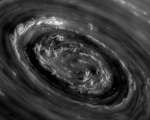 In the Center of Saturns North Polar Vortex
4.12.2012
What's happening at the north pole of Saturn? A vortex of strange and complex swirling clouds. The center of this vortex was imaged in unprecedented detail last week by the robotic Cassini spacecraft orbiting Saturn. These clouds lie at the center of the unusual hexagonal cloud system that surrounds the north pole of Saturn.
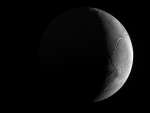 Crescent Enceladus
9.02.2017
Peering from the shadows, the Saturn-facing hemisphere of tantalizing inner moon Enceladus poses in this Cassini spacecraft image. North is up in the dramatic scene captured last November as Cassini's camera was pointed in a nearly sunward direction about 130,000 kilometers from the moon's bright crescent.
|
January February March April May June July August September October |
|||||||||||||||||||||||||||||||||||||||||||||||||