
|
You entered: spacecraft
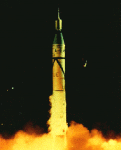 The First Explorer
6.02.1999
The first US spacecraft was Explorer 1. The cylindrical 30 pound satellite was launched (above) as the fourth stage of a Jupiter-C rocket (a modified US Army Redstone ballistic missile) and achieved orbit on January 31, 1958.
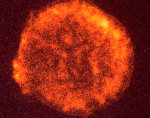 Tychos Supernova Remnant in X ray
7.03.1999
How often do stars explode? By looking at external galaxies, astronomers can guess that these events, known as a supernovae, should occur about once every 30 years in a typical spiral galaxy like our MilkyWay.
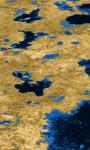 Liquid Lakes on Saturns Titan
7.02.2007
Why would some regions on Titan reflect very little radar? The leading explanation is that these regions are lakes, possibly composed of liquid methane. The above image is a false-color synthetic radar map of a northern region of Titan taken during a flyby of the cloudy moon by the robotic Cassini spacecraft last July.
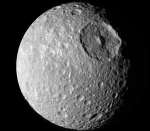 Mimas: Small Moon with a Big Crater
17.05.2009
Whatever hit Mimas nearly destroyed it. What remains is one of the largest impact craters on one of Saturn's smallest moons. The crater, named Herschel after the 1789 discoverer of Mimas, Sir William Herschel, spans about 130 kilometers and is pictured above.
 Comet ISON Before and After
29.11.2013
Sungrazing Comet ISON reached perihelion, its closest approach to the Sun, yesterday, November 28, at 18:45 UT. The comet passed just over 1 million kilometers above the solar surface, a distance less than the diameter of the Sun.
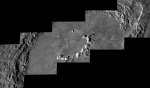 The Great Crater Hokusai
18.04.2015
One of the largest young craters on Mercury, 114 kilometer (71 mile) diameter Hokusai crater's bright rays are known to extend across much of the planet. But this mosaic of oblique views focuses...
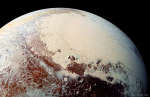 Plutos Sputnik Planum
22.11.2016
Is there an ocean below Sputnik Planum on Pluto? The unusually smooth 1000-km wide golden expanse, visible in the featured image from New Horizons, appears segmented into convection cells. But how was this region created?
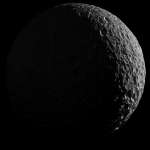 Mimas in Saturnlight
16.03.2017
Peering from the shadows, the Saturn-facing hemisphere of Mimas lies in near darkness alongside a dramatic sunlit crescent. The mosaic was captured near the Cassini spacecraft's final close approach on January 30, 2017. Cassini's camera was pointed in a nearly sunward direction only 45,000 kilometers from Mimas.
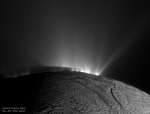 Life Enabling Plumes above Enceladus
16.04.2017
Does Enceladus have underground oceans that could support life? The discovery of jets spewing water vapor and ice was detected by the Saturn-orbiting Cassini spacecraft in 2005. The origin of the water feeding the jets, however, was originally unknown.
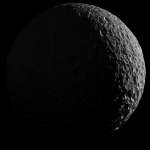 Mimas in Saturnlight
3.08.2019
Peering from the shadows, the Saturn-facing hemisphere of Mimas lies in near darkness alongside a dramatic sunlit crescent. The mosaic was captured near the Cassini spacecraft's final close approach on January 30, 2017. Cassini's camera was pointed in a nearly sunward direction only 45,000 kilometers from Mimas.
|
January February March April May June July August September October |
|||||||||||||||||||||||||||||||||||||||||||||||||