
|
You entered: spacecraft
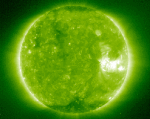 The Iron Sun
21.05.1996
The ultraviolet light emitted by eleven times ionized iron at temperatures over 2 million degrees Farenheit was used to record the above picture of the Sun on May 16. The image was made by the EIT camera onboard the SOHO spacecraft, a space observatory which can continuously observe the Sun.
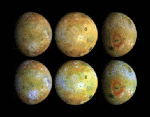 Three Views of Jupiter's Io
3.10.1996
The Galileo spacecraft orbiting Jupiter continues to return impressive results. The Galileo team has just released three more photographs of Jupiter's volcanic moon Io taken in June. These three photos are reflected at the bottom of the above picture, digitally enhanced to better show important features.
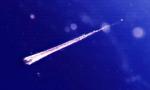 Catching Falling Stardust
1.02.1997
This carrot shaped track is actually little more than 5 hundredths of an inch long. It is the trail of a meteroid through aerogel exposed to space by the shuttle launched EURECA (European Recoverable Carrier) spacecraft.
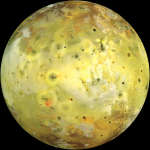 Io in True Color
3.10.2010
The strangest moon in the Solar System is bright yellow. This picture, an attempt to show how Io would appear in the "true colors" perceptible to the average human eye, was taken in 1999 July by the Galileo spacecraft that orbited Jupiter from 1995 to 2003.
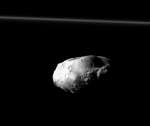 Prometheus and the F Ring
8.01.2016
In Greek myth Prometheus was a Titan, known for bringing fire from Mount Olympus. But in modern times the name is given to is a small moon of Saturn, orbiting just inside Saturn's F ring.
 APOD: 2023 April 30 Б Saturns Moon Helene in Color
30.04.2023
Although its colors may be subtle, Saturn's moon Helene is an enigma in any light. The moon was imaged in unprecedented detail in 2012 as the robotic Cassini spacecraft orbiting Saturn swooped to within a single Earth diameter of the diminutive moon.
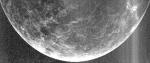 A Radar Image of Venus
15.05.2001
The largest radio telescopes in the world are working together to create a new map of the surface of Venus. The surface of Venus is unusually hidden by a thick atmosphere of mostly carbon dioxide gas. These thick clouds are transparent, however, to radar signals sent and received from Earth.
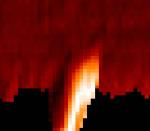 Tornadoes on the Sun
29.04.1998
Giant spinning clouds of gas, similar to Earth's tornadoes, have been found on the Sun. Solar tornadoes, however, can be larger than the entire Earth, and sustain wind gusts over 1000 times stronger than their Earth counterparts.
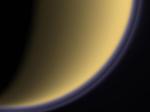 The Double Haze above Titan
10.08.2004
Most moons have no haze layer at all - why does Titan have two? Images from the Cassini spacecraft that slipped into orbit around Saturn last month confirm that the Solar System's most mysterious moon is surrounded not only by a thick atmosphere but also by two distinct spheres of haze.
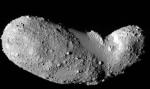 APOD: 2005 December 28- Smooth Sections on Asteroid Itokawa
28.12.2005
What are parts of this asteroid's surface so smooth? No one is yet sure, but it may have to do with the dynamics of an asteroid that is a loose pile of rubble rather than a solid rock.
|
January February March April May June July August September October |
|||||||||||||||||||||||||||||||||||||||||||||||||