
|
You entered: spacecraft
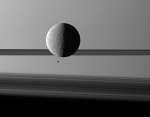 Moons and Rings Before Saturn
31.05.2010
While cruising around Saturn, be on the lookout for picturesque juxtapositions of moons and rings. Another striking alignment occurred last March in the view of humanity's Saturn-orbiting Cassini spacecraft. Rhea, one of Saturn's larger moons, was caught passing Epimetheus, one of Saturn's smaller moons.
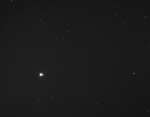 Earth and Moon from MESSENGER
1.09.2010
What does Earth look like from the planet Mercury? The robotic spacecraft MESSENGER found out as it looked toward the Earth during its closest approach to the Sun about three months ago. The Earth and Moon are visible as the double spot on the lower left of the above image.
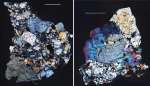 Vesta Rocks
10.12.2011
These colorful images are of thin slices of meteorites viewed through a polarizing microscope. Part of the group classified as HED meteorites for their mineral content (Howardite, Eucrite, Diogenite), they likely fell to Earth from 4 Vesta, the mainbelt asteroid currently being explored by NASA's Dawn spacecraft.
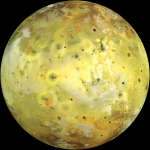 Io in True Color
30.03.2014
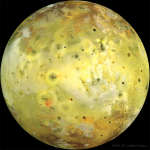
The strangest moon in the Solar System is bright yellow. This picture, an attempt to show how Io would appear in the "true colors" perceptible to the average human eye, was taken in 1999 July by the Galileo spacecraft that orbited Jupiter from 1995 to 2003.
 APOD: 2026 January 20 Б Io in True Color
19.01.2026
The strangest moon in the Solar System is bright yellow. The featured picture, an attempt to show how Io would appear in the "true colors" perceptible to the average human eye, was taken in 1999 July by the Galileo spacecraft that orbited Jupiter from 1995 to 2003.
 Sun and Winter Solstice 1996
20.12.1996
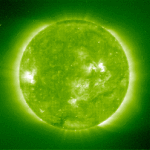
Today is the Winter Solstice for 1996. After steadily sinking in Northern Hemisphere skies, the Sun is now at its lowest declination - marking the first day of Northern Winter (but Southern Summer!). The Earth...
 The Rings of Saturn
30.07.1995
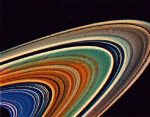
Saturn's spectacular system of bright rings has been the subject of study and wonder since Galileo first turned his telescope on the ringed planet in 1610. To Galileo, the blurry image produced by his small telescope was confusing. Saturn appeared to him to have "ear-like" appendages which he thought might be large moons.
 Uranus's Moon Oberon: Impact World
8.04.1996
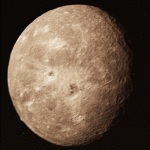
Oberon is the most distant and second largest moon of Uranus. Discovered by William Herschel in 1787, the properties of the world remained relatively unknown until the robot spacecraft Voyager 2 passed it during its flyby of Uranus in January 1986.
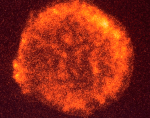 Tycho's Supernova Remnant in X-ray
23.06.1996
How often do stars explode? By looking at external galaxies, astronomers can guess that these events, known as a supernovae, should occur about once every 30 years in a typical spiral galaxy like our MilkyWay.
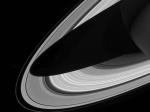 A Shadow on the Rings of Saturn
21.07.2004
This picture of Saturn could not have been taken from Earth. No Earth based picture could possibly view the night side of Saturn and the corresponding shadow cast across Saturn's rings. Since Earth is much closer to the Sun than Saturn, only the day side of the planet is visible from the Earth.
|
January February March April May June July August September October |
|||||||||||||||||||||||||||||||||||||||||||||||||