
|
You entered: spacecraft
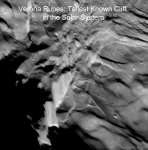 Verona Rupes: Tallest Known Cliff in the Solar System
29.11.2020
Could you survive a jump off the tallest cliff in the Solar System? Quite possibly. Verona Rupes on Uranus' moon Miranda is estimated to be 20 kilometers deep -- ten times the depth of the Earth's Grand Canyon.
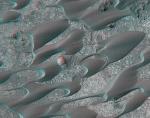 Mars: 3 D Dunes
15.08.2001
Get out your red/blue glasses and treat yourself to this dramatic 3-D view of sand dunes on Mars! The field of undulating dunes is found in Nili Patera, a volcanic depression in central Syrtis Major, the most prominent dark feature on the Red Planet.
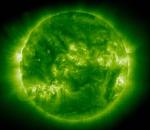 The Iron Sun
29.09.2001
The ultraviolet light emitted by eleven times ionized iron at temperatures over 2 million degrees Farenheit was used to record the above picture of the Sun on September 22, the date of the autumnal equinox.
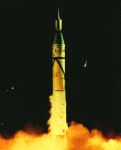 The First Explorer
10.02.1996
The first US spacecraft was Explorer 1. The cylindrical 30 pound satellite was launched (above) as the fourth stage of a Jupiter-C rocket (a modified US Army Redstone ballistic missile) and achieved orbit on January 31, 1958.
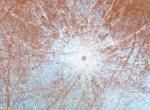 Pwyll: Icy Crater of Europa
17.04.1997
The impact crater Pwyll (a name from Celtic Mythology) is thought to represent one of the youngest features on the surface of Jupiter's moon Europa. A combination of color and high resolution black...
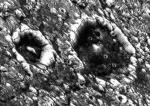 Dark Craters on Ganymede
22.07.1998
Ganymede has craters within craters within craters. The old surface of the largest moon in the Solar System shows its age by the large amount of these impact features. The above picture released last...
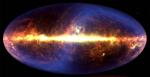 The Infrared Sky
28.01.1998
Three major sources contribute to the far-infrared sky: our Solar System, our Galaxy, and our Universe. The above image, in representative colors, is a projection of the entire infrared sky created from years of observations by the robot spacecraft COBE.
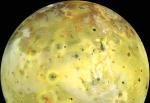 Io in True Color
20.09.1999
The strangest moon in the Solar System is bright yellow. This recently released picture, showing Io's true colors, was taken in July by the Galileo spacecraft currently orbiting Jupiter. Io's colors derive from sulfur and molten silicate rock. The unusual surface of Io is kept very young by its system of active volcanoes.
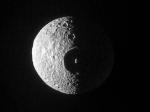 Crater on Mimas
8.03.2005
Whatever hit Mimas nearly destroyed it. What remains is one of the largest impact craters on one of Saturn's smallest moons. The crater, named Herschel after the 1789 discoverer of Mimas, Sir William Herschel, spans about 130 kilometers and is pictured above in the dramatic light of its terminator.
 A Solar System Portrait
5.05.1999
As the Voyager 1 spacecraft headed out of our Solar System, it looked back and took a parting family portrait of the Sun and planets. From beyond Pluto, our Solar System looks like a bright star surrounded by faint dots. In the above picture, the Sun is so bright it is blocked out for contrast.
|
January February March April May June July August September October |
|||||||||||||||||||||||||||||||||||||||||||||||||